What is the Building Safety Levy?
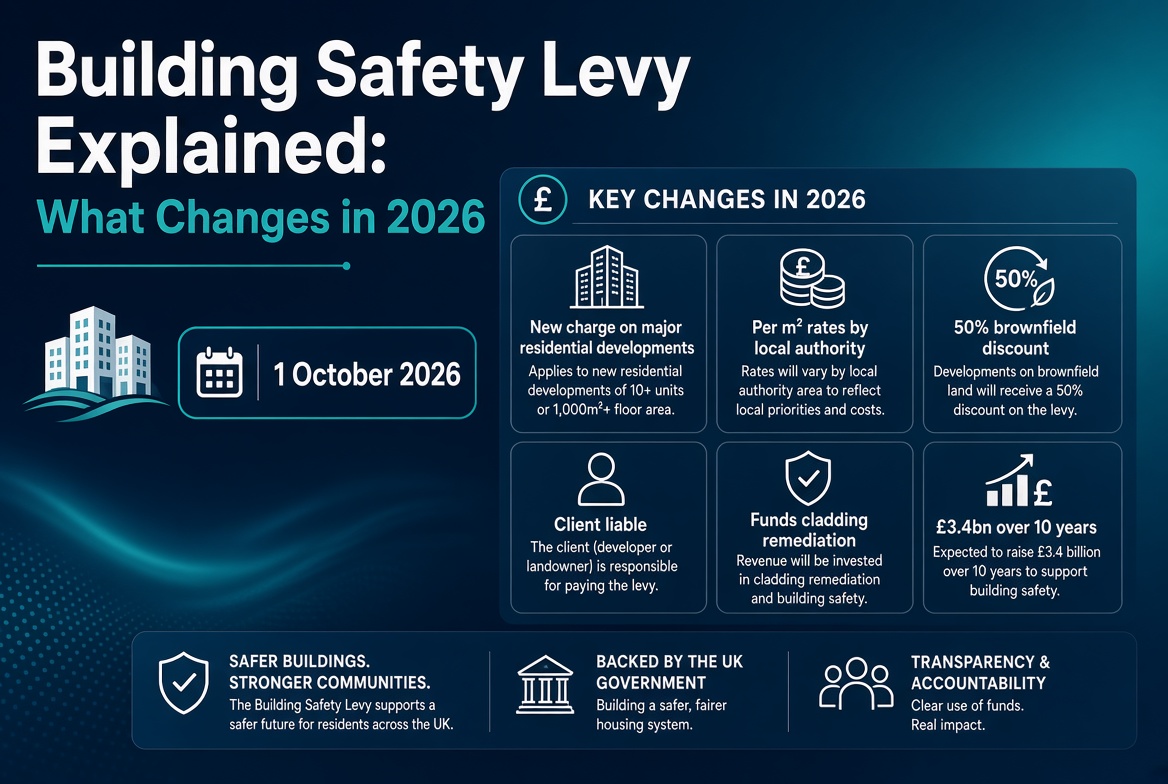
The Building Safety Levy is a charge on new residential developments in England, introduced under the Building Safety Act 2022. It's designed to fund the remediation of building safety defects — primarily unsafe cladding — across the country, on the principle that the cost of making buildings safe shouldn't fall on residents. The Building Safety Levy (England) Regulations 2025 were made on 19 November 2025, and the levy comes into force on 1 October 2026, having originally been due a year earlier before being delayed.
The government estimates the levy will raise approximately £3.4 billion over ten years.
Who does it apply to?
The levy applies to major residential developments, defined as schemes producing:
- At least 10 new dwellings, or
- At least 30 new bedspaces in purpose-built student accommodation (PBSA)
Mixed-use schemes may also be caught if they meet these thresholds. The regulations include anti-avoidance provisions, so splitting an application to stay under the 10-dwelling threshold won't sidestep the charge.
Developments of fewer than 10 dwellings (or 30 PBSA bedspaces) generally sit outside the levy — unless the works form part of a wider planning permission for a major residential development.
How is it calculated?
The levy is charged per square metre of chargeable gross internal floorspace, with the rate depending on the local authority area where the development sits. Rates were set using average local house prices, so areas with higher property values carry higher levy rates. Reported rates range widely — from around £13–16 per square metre in Burnley up to roughly £100 per square metre in Kensington and Chelsea.
Two adjustments matter for viability calculations:
- Previously developed ("brownfield") land qualifies for a 50% discount on the standard local authority rate.
- Greenfield sites attract the higher, undiscounted rate.
Levy rates won't be indexed annually — they'll be reviewed every three years.
Who pays, and when?
The named client on the building control application is responsible for the levy where a charge is due. It becomes payable in connection with the building control process, and a completion certificate cannot be issued until the levy is paid — meaning it directly gates project completion, not just planning.
The critical date: 1 October 2026
The single most important detail for anyone with a live project is this: the levy applies based on when the building control application or notice is submitted, not when construction starts or completes.
- Applications, initial notices, and higher-risk building applications submitted before 1 October 2026 are not subject to the levy — including where they're later varied by an amendment or change control application.
- Applications submitted on or after 1 October 2026 fall within scope.
- If a pre-deadline application is later rejected or invalidated and has to be resubmitted after 1 October 2026, it loses its exemption.
This has created a genuine rush: legal and planning advisers are urging developers to review pipeline projects now to see whether building control applications can realistically be submitted ahead of the deadline — while cautioning that rejection and invalidation rates on rushed submissions are "reasonably high," which defeats the purpose if the resubmission lands after 1 October.
Exemptions
Certain building types and uses are exempt from the levy, including some forms of affordable and supported housing — though even exempt projects may still need to provide evidence of their exempt status to the local authority. Full exemption criteria are set out in the regulations (Regulations 7 and 8, and Schedules 1 and 2) and in government guidance.
What developers and site teams should do now
- Check every live pipeline project's building control submission date. If it's realistic to submit before 1 October 2026, weigh the cost of the levy against the cost of accelerating the application.
- Don't cut corners on a rushed pre-deadline submission. An application that's rejected or invalidated and resubmitted after the deadline loses its exemption entirely.
- Confirm previously-developed land status early. The 50% discount depends on meeting the regulatory definition — get the evidence together before the calculation matters.
- Assemble your floorspace and exemption evidence as you go, not retrospectively. Disputes over chargeable floorspace, exempt units, or land status are strongest when supported by the original GIA schedule, planning permission, red-line evidence and exemption documents — not paperwork reconstructed after the fact.
- Treat it as a live cost-planning issue now, not something for the completion team to deal with in 2027 or 2028 — viability assessments on schemes moving toward building control this year need the levy built in.
How this fits into wider compliance record-keeping
The Building Safety Levy adds one more document trail to a project that already has to demonstrate compliance under CDM 2015, BS 5975, and building control requirements. The developers best placed to handle a levy dispute — or simply to avoid one — are the ones with clean, contemporaneous records: floorspace calculations, exemption evidence, and application dates captured as the project moves, not reconstructed under pressure. KaelSite's document and certificate tracking gives project teams a single, timestamped record for exactly this kind of evidence, alongside the inspection and compliance data they're already generating on site.
FAQ
Does the levy apply to commercial developments? No — it applies to major residential developments and purpose-built student accommodation, not standalone commercial schemes.
Is the levy the same as the Residential Property Developer Tax? No. They're separate mechanisms. UK home builders have already committed billions toward remediation through self-remediation commitments and the Residential Property Developer Tax; the Building Safety Levy is an additional, separate charge collected via the building control process.
Who collects the levy? Local authorities collect it, even where building control is shared across areas or handled by an Approved Inspector — legal responsibility for administration sits with the local authority where the development is located.
Can rates change after a scheme starts? Rates are reviewed every three years rather than annually, but a scheme's levy liability is set by the local authority rate in force when the chargeable building control application is submitted.
Sources: GOV.UK (Building Safety Levy: Guidance; Building Safety Levy (England) Regulations 2025); Reed Smith; Browne Jacobson; Womble Bond Dickinson; Shoosmiths; Charles Russell Speechlys; Brady Solicitors; Home Builders Federation (HBF). This article is for general information only and does not constitute legal or planning advice — developers should seek specific advice on individual scheme viability and compliance.

Comments (0)
Add a Comment
No comments yet. Be the first to comment!