Construction Industry Compliance App: What Should a Construction Compliance App Do?
Construction companies deal with compliance every day.
Site inspections, safety checks, training records, certificates, risk observations, issues, corrective actions and site documentation all need to be managed while work continues on site.
Traditionally, much of this information has been managed through paper forms, spreadsheets, emails and separate folders.
A construction industry compliance app brings these processes together into a digital platform that construction teams can use from the site and management teams can access from the office.
But what should a construction compliance app actually do?
What Is a Construction Industry Compliance App?
A construction compliance app is software designed to help construction companies organise and manage compliance-related activities digitally.
Depending on the platform, this can include:
The exact requirements will vary between companies and projects.
The purpose isn't simply to replace paper.
A good construction compliance app should make it easier to capture information, identify problems, assign actions, maintain records and see what needs attention.
Why Do Construction Companies Use Compliance Apps?
Construction sites generate a large amount of information.
A single project can produce hundreds or thousands of records over its lifetime.
These might include:
When these records are spread across different systems, finding information can become difficult.
A compliance app can provide one structured place for managing this information.
What Should the Best Construction Compliance App Include?
Not every construction app offers the same features.
When comparing construction compliance software, look for the following.
1. Mobile-first inspections
Site teams should be able to complete inspections directly from their phones or tablets.
A typical workflow might be:
Open inspection → Complete checklist → Add notes → Take photos → Report issues → Submit
The process should be simple enough to use while working on an active construction site.
2. Digital checklists
Digital checklists can replace many paper inspection forms.
Companies should ideally be able to create or customise checklists for different activities.
For example:
-
Site safety inspections
-
Temporary works inspections
-
Plant inspections
-
Housekeeping inspections
-
Quality checks
-
Environmental inspections
-
Project-specific inspections
The exact checklist should always reflect the company's procedures and the requirements of the particular project.
3. Issue and defect reporting
Finding an issue is only the beginning.
A useful compliance app should allow users to record what was found and provide enough information for someone else to understand the problem.
A report might include:
-
Description
-
Location
-
Category
-
Photograph
-
Date and time
-
Person reporting
-
Assigned person
-
Due date
-
Status
This creates a structured record rather than an isolated message.
4. Corrective action tracking
A strong compliance workflow should continue after an issue has been reported.
For example:
Issue identified → Action assigned → Due date set → Action completed → Evidence added → Closed
This makes it easier to see which issues are still outstanding.
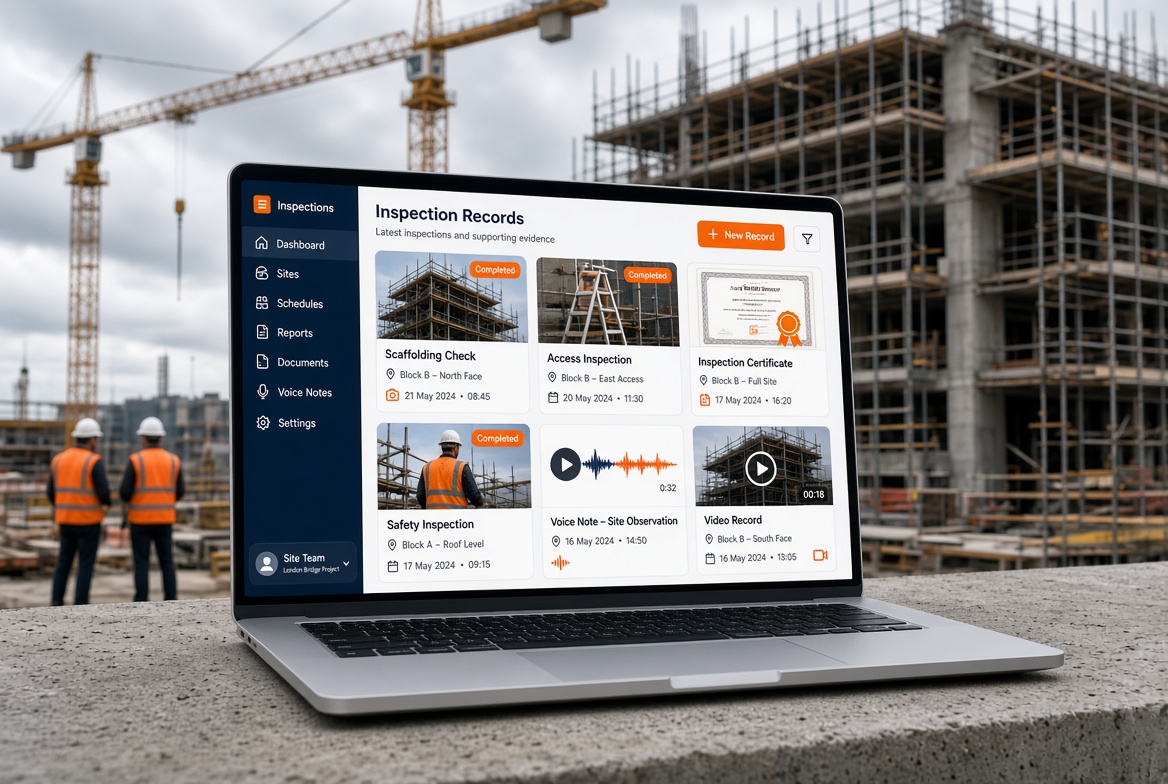
5. Photographic evidence
Construction teams often need photographs to provide context.
A compliance app should make it easy to capture a photograph from the phone and attach it to the relevant record.
For example:
Inspection → Issue → Photo → Corrective action
Keeping these connected can make records easier to understand later.
6. Certificate tracking
Construction companies may manage many certificates and competency-related records.
A digital system can help organise information such as:
The exact records required will depend on the company's processes and project requirements.
7. Certificate expiry reminders
Expiry dates can be difficult to manage manually when a company has many workers and projects.
A compliance platform can provide reminders before an expiry date, helping teams identify records that need attention.
This can be particularly useful for companies managing large teams across multiple sites.
8. Multi-site reporting
Construction companies rarely have only one project.
A larger organisation may need to manage information across:
-
Several construction sites
-
Different project managers
-
Multiple site teams
-
Different clients
-
Different project requirements
Multi-site reporting can provide a central overview while keeping each project's records separate.
Managers may be able to see:
-
Open issues
-
Outstanding actions
-
Recent inspections
-
Expiring certificates
-
Project activity
-
Reports
This creates better visibility across the organisation.
Construction Compliance App: Mobile and Web
A construction company may need both a mobile app and a web platform.
The two interfaces serve different purposes.
On site
Site teams need a quick mobile experience for:
-
Inspections
-
Checklists
-
Photographs
-
Issue reporting
-
Corrective actions
-
Site observations
In the office
Managers and administrators may need a larger web interface for:
This is why a construction app and web-based compliance platform can be particularly useful.
Does a Construction Compliance App Need Offline Working?
It can be an important feature.
Construction sites do not always have reliable internet access.
Basements, remote sites, large developments and areas with poor mobile coverage can all create connectivity problems.
An app that supports appropriate offline workflows can allow users to continue recording information and synchronise it when connectivity returns.
Before choosing software, construction companies should understand exactly what the platform supports offline and what requires an internet connection.
Construction Compliance Software vs Spreadsheets
Spreadsheets are still widely used in construction.
They can be useful for simple tracking and smaller teams.
However, as the amount of information increases, companies may start experiencing problems such as:
-
Multiple versions of the same spreadsheet
-
Manual updates
-
Difficulties tracking actions
-
Missing information
-
Manual expiry reminders
-
Limited mobile usability
-
Difficulties managing photographs
-
Poor visibility across projects
A dedicated compliance platform can structure these workflows more effectively.
| Spreadsheet |
Compliance App |
| Manual data entry |
Structured digital workflows |
| Often separate files |
Centralised platform |
| Limited mobile experience |
Designed for mobile use |
| Manual reminders |
Automated reminders where supported |
| Separate photo storage |
Photos attached to records |
| Manual action tracking |
Assigned actions and statuses |
| Difficult multi-site overview |
Multi-site reporting |
This doesn't mean every construction company needs dedicated software.
The right solution depends on the company's size, processes and requirements.
Construction Compliance App for Site Supervisors
Site supervisors are often the people actually collecting information.
They may need to complete inspections, identify issues and make sure actions are followed up.
A useful app should therefore minimise administration.
For example:
Inspect → Record → Photograph → Assign → Track → Close
Instead of completing a paper form and later transferring the information into another system, the record can be created directly on site.
This can save time and reduce duplicate data entry.
Construction Compliance App for Project Managers
Project managers often need a different level of visibility.
Rather than reviewing individual site records one by one, they may need to know:
-
What issues are currently open?
-
Which actions are overdue?
-
Which projects need attention?
-
Are inspections being completed?
-
Are certificates approaching expiry?
-
What has happened recently on each project?
A central dashboard can make these questions easier to answer.
Construction Compliance App for Compliance Managers
Compliance managers may need to look across the organisation rather than just one project.
For them, useful features can include:
The goal is to make information easier to locate when it is needed.
What About Temporary Works?
Temporary works are another area where structured digital records can be useful.
Depending on the company's procedures, teams may need to manage:
A construction compliance app can help organise these records alongside wider site activities.
However, software does not replace the Temporary Works Procedure, competent people, design checks, approvals or required sign-off.
It is a tool for supporting the management and recording process.
Construction Compliance App and Risk Management
Compliance and risk management are closely connected, but they are not identical.
A digital platform can help teams record and track information such as:
-
Hazards
-
Risk observations
-
Safety issues
-
Near misses
-
Corrective actions
-
Inspection findings
For example:
Hazard identified → Risk recorded → Action assigned → Action completed → Evidence added
This provides a structured workflow for managing reported information.
The app itself does not determine the appropriate level of risk or replace professional risk assessment.
Construction Compliance App and Near-Miss Reporting
Near misses can be difficult to manage when they are reported informally.
A digital workflow can allow workers to report a near miss directly from the site.
A record might contain:
-
What happened
-
Where it happened
-
When it happened
-
Photographs
-
Immediate actions
-
Follow-up actions
-
Responsible person
-
Status
This creates a searchable record that can be reviewed later.
User Permissions and Construction Compliance
A construction compliance platform should also consider who can see and change information.
Different users may need different permissions.
For example:
| User |
Possible Access |
| Site worker |
Create reports |
| Site supervisor |
Manage site inspections |
| Project manager |
Review project records |
| Compliance manager |
Review multiple projects |
| Senior management |
Company-level overview |
| Administrator |
Manage users and settings |
The exact permission structure should reflect the company's organisational arrangements.
What Is the Best Construction Compliance App?
There isn't one app that is automatically best for every construction company.
Instead, look for software that matches how your teams actually work.
Ask:
Is it easy to use on site?
If completing a basic inspection requires too many steps, adoption can suffer.
Can it manage multiple projects?
This is important for contractors working across several sites.
Can users attach photographs?
Visual evidence can make reports much more useful.
Can it track corrective actions?
A report should not simply disappear after submission.
Can it manage expiry dates?
Certificate reminders can reduce reliance on manual calendars and spreadsheets.
Does it have mobile and web access?
Site teams and management teams have different needs.
Does it support offline working?
This can be important for sites with unreliable connectivity.
Can users have different permissions?
Not every employee needs access to every project or record.
Can information be searched later?
Historical records are much more useful when they can be found quickly.
How KaelSite Supports Construction Compliance
KaelSite is built around the day-to-day workflows of construction teams.
Instead of requiring separate systems for every type of site record, KaelSite brings several construction workflows together.
Teams can use KaelSite to support:
This means a site supervisor can capture information where the work happens, while managers can review and manage information from a central platform.
The objective is simple:
Make construction compliance easier to record, easier to manage and easier to find.
KaelSite is a support tool. It does not replace competent people, project procedures, legal duties, engineering decisions, inspections, approvals or required sign-off.
Construction Compliance App Checklist
Before choosing software, ask whether it provides:
Frequently Asked Questions
What is a construction industry compliance app?
It is software designed to help construction companies digitally manage compliance-related activities such as inspections, records, issues, corrective actions, certificates and reporting.
What should a construction compliance app include?
Useful features can include digital inspections, checklists, issue reporting, corrective actions, photo evidence, certificate tracking, expiry reminders, multi-site reporting, permissions and reporting.
Can a construction compliance app replace paper forms?
It can replace many paper-based workflows, depending on the company's procedures and requirements. Some documents or processes may still require specific formats or approvals.
Can construction compliance software manage multiple sites?
Yes. Many platforms are designed to manage multiple projects while keeping each project's information organised separately.
Can a construction compliance app track certificate expiry dates?
Some platforms provide certificate tracking and expiry reminders. This can be useful for organisations managing large numbers of workers and records.
Is a construction compliance app the same as construction management software?
Not necessarily. Construction management software can cover a much wider range of activities, while compliance software focuses more specifically on inspections, records, risks, issues, actions and compliance-related workflows. Some platforms combine both.
Is construction compliance software suitable for small companies?
It can be. The important factor is whether the software is simple enough for the size of the organisation and provides features that genuinely solve its administrative problems.
Can construction compliance apps work offline?
Some do. Offline capability varies between platforms, so it is important to check exactly which functions remain available without an internet connection.
Conclusion
Construction compliance involves much more than storing documents.
Site teams need practical ways to complete inspections, report problems, capture evidence and follow up actions. Managers need visibility across projects, while compliance teams need organised and searchable records.
A well-designed construction industry compliance app can bring these processes together.
The best solution is not necessarily the platform with the most features.
It is the one that construction teams can actually use on site, while giving managers the information they need to manage projects effectively.
For companies looking for a mobile and web-based approach to construction compliance, KaelSite brings inspections, issues, evidence, actions, certificates and multi-site reporting into one construction-focused platform.
Comments (0)
Add a Comment
No comments yet. Be the first to comment!