The scale of the problem
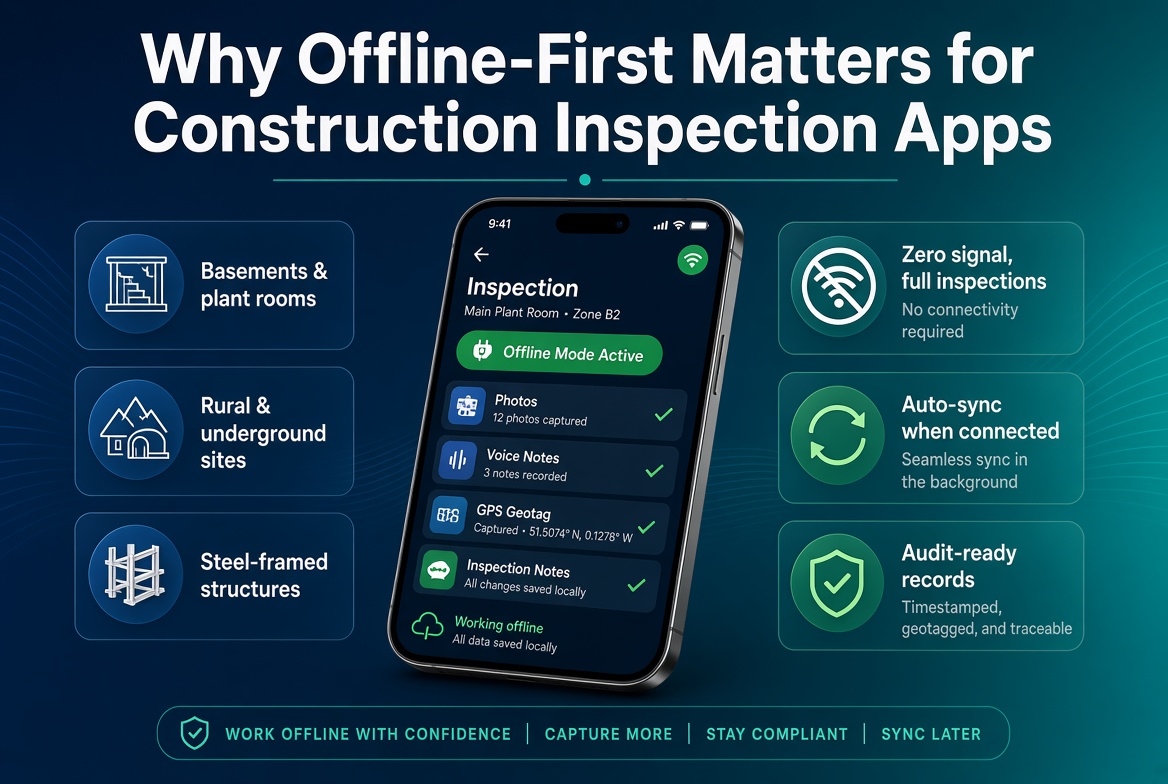
An estimated 15–30% of field locations experience unreliable network access at any given time, particularly in remote, indoor, underground, or mobile environments, and inspection coverage becomes inconsistent as a result. That's not a rare edge case — it's a routine chunk of any given site. Basements, rural locations and steel-framed structures all create dead zones as a matter of course, not an exception to plan around.
The knock-on effect isn't abstract. Research into safety and compliance programmes indicates that missed inspections are disproportionately correlated with connectivity gaps rather than inspector negligence or intent. In other words: when the app can't cope with the dead zone, the inspection doesn't happen — or it happens on paper and gets forgotten before it's transcribed.
"Works offline" and "offline-first" are not the same thing
This is where most site teams get caught out. Plenty of apps claim offline support but really only offer view-only mode — you can see previously downloaded content, but you can't create or save a new inspection without a connection. That's not offline capability, it's a cache.
A genuinely offline-first app should let you:
- Start and complete a full inspection with zero signal
- Attach photos, voice notes, and GPS/geotag data locally
- Save the record permanently to the device, not just hold it in memory
- Sync automatically the moment connectivity returns, with nothing lost if the app closes or the battery dies first
If closing the app or losing battery before reconnecting means the inspection is gone, it was never truly offline — it was just delayed.
Why this matters more for compliance than convenience
It's tempting to file this under "nice to have." It isn't. For UK construction compliance specifically, three things make offline-first a genuine risk-management issue rather than a UX preference:
Timestamp accuracy. Regulators and auditors expect inspection records to reflect when something was actually checked. If a crew has to wait until they're back in signal to log a walkaround completed at 7am, the timestamp on the record no longer matches reality — and that gap is exactly what gets questioned in an investigation.
Evidence chain of custody. Photos, GPS coordinates and signatures captured at the point of inspection create a record that holds up under scrutiny. Photos taken on a phone and uploaded later, disconnected from the original inspection, don't carry the same weight.
Consistency across the register. A Temporary Works Register or certificate log is only useful if it's complete. Gaps caused by connectivity — not by anyone skipping a check — still show up as gaps when HSE or an internal auditor reviews the record.
What "good" looks like in practice
When evaluating any inspection or compliance app for UK site use, a few questions cut through the marketing quickly:
- Can I start a brand-new inspection form with the phone in airplane mode? Not just view an old one — build a new record from scratch.
- Can I attach photos, video, or voice notes offline, and do they stay attached once the record syncs?
- Is the GPS/geotag captured at the moment of inspection, not backfilled once signal returns?
- What happens if the app crashes or the battery dies before syncing? If the answer is "you lose the inspection," that's not offline-first.
- How much can be stored locally before it needs to sync? Devices with reasonable storage should comfortably hold weeks of inspections, including photos, without issue.
Built for how UK sites actually work
KaelSite was built offline-first from the ground up — not as a bolt-on feature. Inspections, photo/video/voice evidence, and geotagging all work with zero signal, and everything syncs automatically the moment the device reconnects, with nothing lost in between. For Site Managers and Compliance Officers, that means the Temporary Works Register, certificate tracking, and issue reporting stay complete and audit-ready, regardless of which basement, plant room, or rural site the inspection happened in.
The bottom line
Dead zones aren't a technical inconvenience on UK construction sites — they're the default operating environment. An inspection app that only works with signal isn't a compliance tool for the sites where compliance is hardest to maintain. If you're evaluating one, don't take "works offline" at face value — ask what actually happens when the signal drops mid-inspection.

Comments (0)
Add a Comment
No comments yet. Be the first to comment!