The standard: BS 5975:2024
The UK's temporary works framework moved from the single BS 5975:2019 standard to a two-part structure — BS 5975-1:2024 and BS 5975-2:2024 — which came into effect on 31 December 2024. Part 1 covers the management procedures for controlling temporary works; content still referencing the 2019 edition is now out of date. BS 5975 itself is not law, but HSE guidance treats it as the industry-recognised way of discharging the temporary works duties that already sit under CDM 2015 and the Health and Safety at Work etc. Act 1974.
TWC: Temporary Works Coordinator
The Temporary Works Coordinator is the senior, project-level role. Appointed by the contractor, the TWC coordinates the planning, design, checking, implementation, use and dismantling of all temporary works on a project — everything from falsework and formwork to scaffolding, excavation support, propping, façade retention, crane and piling bases, and hoardings.
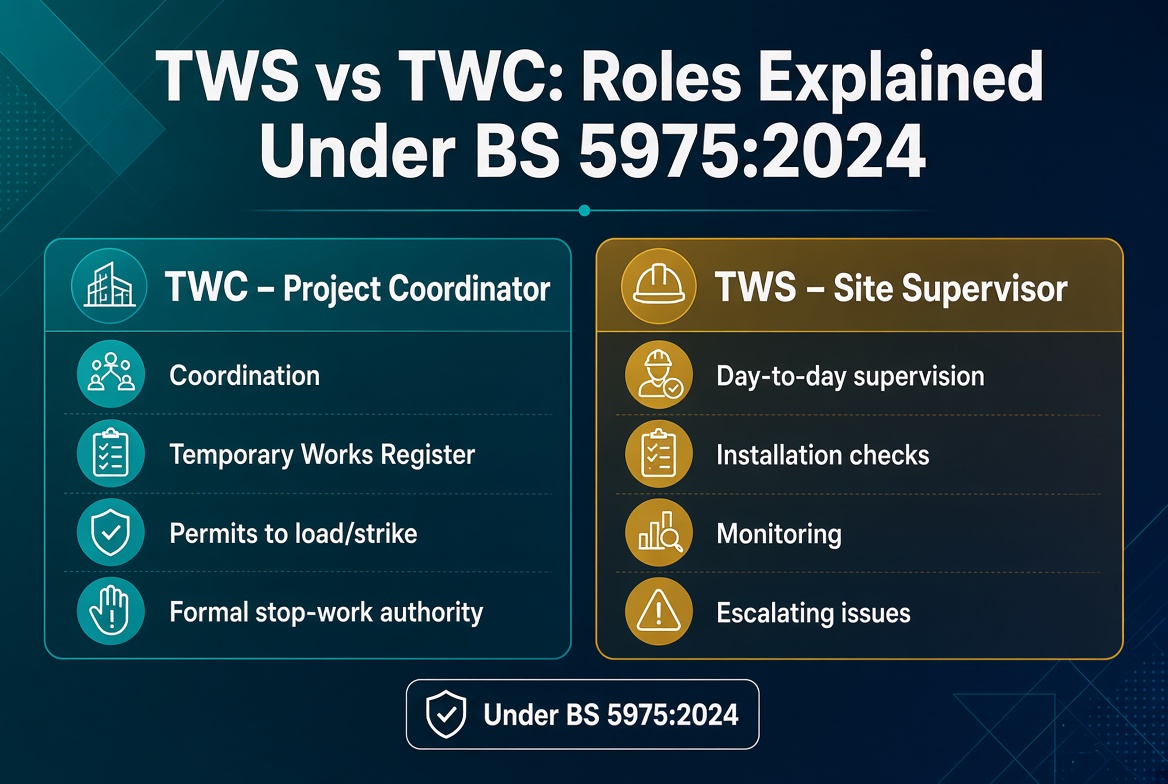
Key TWC responsibilities:
- Maintaining the temporary works register, listing every item of temporary works, its current status (designed, checked, installed, loaded, removed), and who's responsible at each stage
- Ensuring designs are independently checked at a level appropriate to risk (BS 5975 defines four checking categories, and the TWC confirms the right category is applied)
- Issuing permits to load and permits to strike/dismantle
- Holding formal authority to stop work on unsafe or non-compliant temporary works — backed in writing by the organisation's Designated Individual
- Monitoring temporary works throughout their period of use, not just at installation
Critically, the TWC is a coordination and procedural control role, not a design role. HSE is explicit on this point — coordination is a deliberately broader responsibility than producing calculations or drawings, which is the job of the Temporary Works Designer (TWD).
On smaller projects, a site manager may take on the TWC role themselves, provided they're competent and hold sufficient authority. On larger or multi-contractor projects, it's usually a dedicated appointment.
TWS: Temporary Works Supervisor
The Temporary Works Supervisor is a site-based role that supports the TWC — typically used on larger or multi-subcontractor sites where one coordinator can't be physically present across every zone.
Key TWS responsibilities:
- Inspecting installation against the approved design
- Ensuring temporary works are installed, maintained and used in accordance with approved designs and procedures
- Acting as the link between design intent and what's actually built on site
- Flagging issues quickly when what's on the ground doesn't match the approved design
The TWS reports to the TWC and does not replace the TWC's decision-making authority. Permits are not issued independently by a TWS unless this is specifically delegated to them in writing.
TWS vs TWC: the core difference
| |
TWC (Coordinator) |
TWS (Supervisor) |
| Level |
Project-level, senior |
Site-based, delegated |
| Focus |
Coordinates the whole temporary works process |
Supervises day-to-day installation and use |
| Design role |
No — procedural control, not design |
No — checks against approved design |
| Permits |
Issues permits to load/strike |
Only if formally delegated in writing |
| Register |
Maintains the temporary works register |
Feeds inspection findings into it |
| Authority to stop work |
Formal, written authority |
Escalates to TWC unless delegated |
| Typical appointment |
One per project (or per site manager on smaller jobs) |
One or more per site, supporting the TWC |
The plan-and-manage vs monitor-and-flag distinction is the simplest way to remember it: the TWC plans and manages the system; the TWS watches what's actually happening on the ground and reports back.
Where the Designated Individual fits in
BS 5975 also defines a third role above both: the Designated Individual (DI), typically a senior manager within the contracting organisation who formally appoints the TWC and provides the organisational backing for the TWC's stop-work authority. Getting this appointment chain right — DI to TWC to TWS — is what gives the stop-work authority its legal and organisational weight on site.
Why the confusion causes real risk
The consequences of unclear temporary works roles aren't theoretical — HSE prosecutions linked to temporary works failures repeatedly cite unclear responsibility, missing registers, or work loaded without permit as contributing factors. A responsibilities matrix — a simple document setting out exactly who does what at each stage — helps prevent gaps, particularly on projects with multiple contractors and constrained working environments.
This is where digital tools add real value: keeping the temporary works register, permit records and TWC/TWS sign-offs in one place — rather than split across paper forms and individual site managers' memory — makes it far easier to demonstrate that the correct chain of authority was followed. KaelSite's Form Studio and Issue System let teams build a temporary works register and permit workflow specific to their project, with photo and geotag evidence attached at each inspection stage.
FAQ
Can one person be both TWC and TWS? On smaller projects, yes — a competent site manager can hold the TWC role, and depending on project size may also handle TWS-level site checks. On larger or higher-risk projects, these are typically separate, dedicated appointments.
Is TWC or TWS a legally required job title? No — the title itself isn't a statutory requirement. The underlying duties come from CDM 2015 and the Health and Safety at Work etc. Act 1974; BS 5975 is the recognised industry method for discharging them.
What training is needed for these roles? CITB-accredited Temporary Works Coordinator and Temporary Works Supervisor courses are the standard route. This article is a reader-level overview and isn't a substitute for that training or for site-specific legal advice.
Does BS 5975-2:2024 change the TWC/TWS roles? Part 2 sits alongside Part 1 within the same 2024 standard; Part 1 is the one that defines the management procedures, roles and responsibilities covered here.
Sources: BSI (BS 5975-1:2024, BS 5975-2:2024); HSE guidance on temporary works; industry commentary from hseblog.com, FORGE Command, CST Training, and Construction Magazine UK. This article is for general orientation only and does not replace CITB-accredited training or professional advice on specific CDM 2015 compliance matters.

Comments (0)
Add a Comment
No comments yet. Be the first to comment!