Why CITB changed the rules
Demand for CITB-funded training has grown fast. Employer engagement in the Employer Networks programme rose 36% over four years, and by February 2026 CITB had already committed its entire first-quarter budget for Employer Network courses, leaving a gap where no new funded bookings could be made until April. CITB says the levy rate hasn't kept pace with this demand, so it had to change how funding is allocated to keep supporting as many employers as possible.
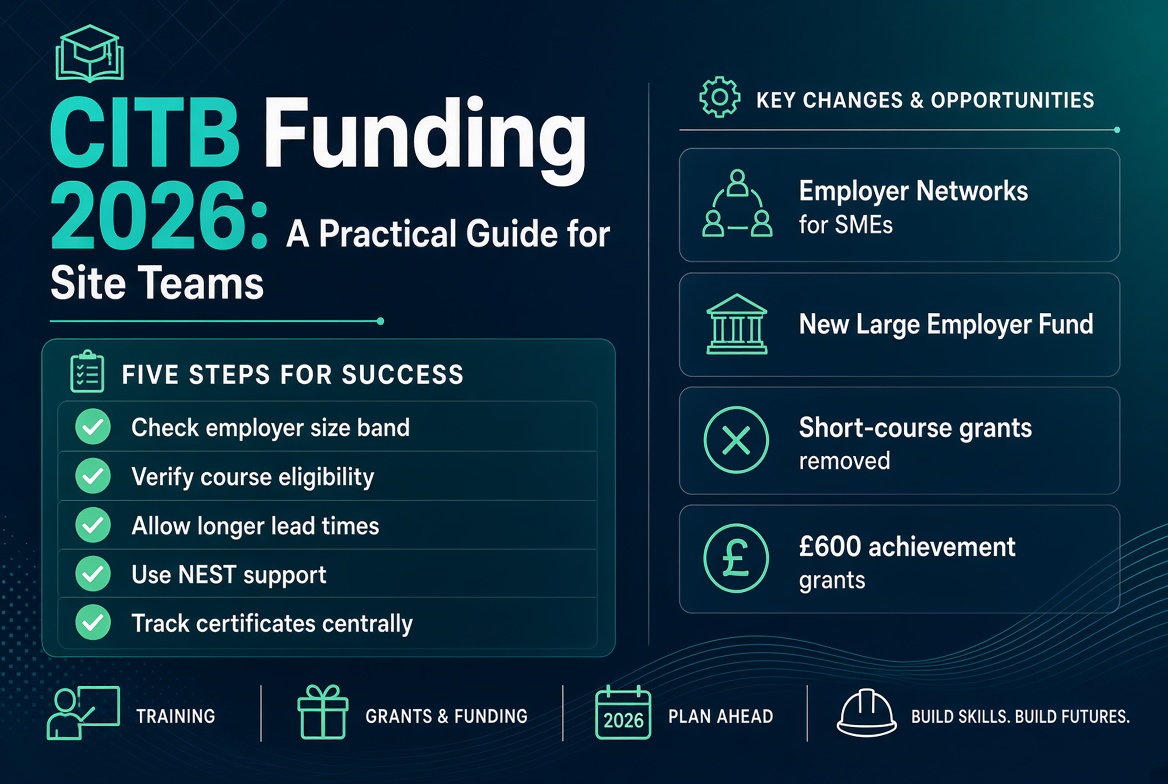
What's changed, and when
| Change |
Effective date |
What it means |
| Employer Networks funding refocused |
From April 2026 |
Support now targets micro, small and medium employers (1–249 staff) |
| Large Employer Fund introduced |
2026–27 (interim, one year) |
New route for larger employers, separate from Employer Networks |
| Short-course training grant removed |
From 8 January 2026 |
Employer Networks becomes the main funding route for most short courses |
| Employer Networks match funding rate cut |
From January 2026 |
Reduced to 50% match funding |
| Level 7 qualification funding stopped |
From January 2026 |
No longer grant-funded |
| Attendance grants for long qualifications stopped |
From January 2026 |
No longer available |
| Non-apprentice achievement grants standardised |
From January 2026 |
Set at a flat £600 |
Some courses, including plant, scaffolding and other exempt standards — remain covered under Short Course Grants, and CITB's New Entrant Support Team (NEST) still offers advisory support on the most appropriate training routes.
Practical guide: protecting your training budget
1. Check your employer size band before you book. Funding routes now differ depending on whether you're classed as micro/small/medium (1–249 employees) or large. Confirm which category your business falls into before assuming a course qualifies for Employer Networks funding — large employers should be looking at the new Large Employer Fund instead.
2. Don't assume a course is grant-funded — verify first. With the short-course training grant removed and Employer Networks now the main route, previously "automatic" funding for short courses is no longer guaranteed. Check current eligibility on CITB's site or through your Employer Network contact before scheduling training around an assumed grant.
3. Build in longer lead times. CITB has already shown it can exhaust a quarter's Employer Network budget early, as happened in Q1 2026. If your team needs training booked before a certification deadline, book earlier in the funding cycle rather than close to it, and have a contingency plan if funding runs out before your slot.
4. Reassess Level 7 and long-qualification plans. If you had senior staff working toward Level 7 qualifications or long courses that relied on attendance grants, those funding routes have stopped. Budget for these separately or explore alternative funding sources such as apprenticeship levy transfers where applicable.
5. Use NEST for route planning, not just funding checks. CITB's New Entrant Support Team can help identify the most appropriate — and currently funded — training pathway for your workforce, which is especially useful now that funding routes have diverged by employer size.
6. Track certificate and grant status centrally, not by memory. With funding rules now more fragmented — different rates, different employer bands, an interim fund with a one-year window — relying on informal tracking increases the risk of missed renewals or wasted training spend. A shared, site-wide record of who's trained, what's funded, and when certificates expire reduces that risk. This is exactly the gap KaelSite's certificate and expiry alert features are designed to close, giving compliance leads a single view instead of chasing spreadsheets or individual site managers.
Common pitfalls to avoid
- Booking training assuming last year's grant still applies. Short-course grants have been restructured; check current terms every time.
- Missing the Large Employer Fund's interim status. It's a one-year measure for 2026–27 — don't build long-term training plans around it without watching for what replaces it.
- Overlooking employer band eligibility. A business that grew past 249 employees during the year may no longer qualify for standard Employer Networks funding.
- Leaving Level 7 and long-course funding gaps unbudgeted. These grants have stopped; factor the cost into your own training budget rather than discovering the gap mid-course.
FAQ
Is the CITB levy itself changing? The funding and grant distribution rules have changed, but this is separate from the levy rate employers pay in, which is set through CITB's periodic levy consensus process.
Do these changes affect ongoing apprenticeships? Apprenticeship achievement grants continue but have been standardised — check current rates for your specific apprenticeship route with CITB directly.
What if my Employer Network funding runs out before I can book? As happened in early 2026, CITB has paused new bookings mid-quarter when budgets are exhausted. If this happens, you can typically book training for dates after the next funding period begins — plan training schedules with this possibility in mind.
Where can I check current eligibility? CITB's website and your local Employer Network contact are the most reliable sources, since funding terms are being reviewed through 2026–27.
Sources: CITB (citb.co.uk); Construction News; SIMIAN.

Comments (0)
Add a Comment
No comments yet. Be the first to comment!