Content
If you work in UK construction, you have probably come across CITB. It might have been a Site Safety Plus course, a grant application or the levy on your payroll. But what is CITB, where did it come from, and what does it do for the industry today?
What is CITB?
CITB stands for the Construction Industry Training Board. It is the employer-led and funded skills and standards body for the construction industry in Great Britain, set up in 1964, and it operates as both a charity and a non-departmental public body. Its stated purpose is to support a skilled, competent and inclusive construction workforce, now and in the future. CITB covers England, Scotland and Wales. Northern Ireland has its own separate body, CITB NI.
A short history of CITB
1964: the beginning. CITB was established on 21 July 1964 as one of 21 industrial training boards created after the Industrial Training Act, mainly to address concerns about skills shortages. These boards could collect a levy from firms in their sector and redistribute it as grants and funding for training, against standards the boards also set.
1966: the first training centre. CITB’s first training centre opened at Bircham Newton in Norfolk. Further centres followed, eventually forming what became known as the National Construction College.
1982 and 1989: the fight to keep the levy. The Industrial Training Act 1982 replaced most training boards with voluntary employer-led bodies that could no longer raise a levy by law. In 1989, construction employers argued strongly that CITB should keep its levy system. As a result, CITB is now one of very few industrial training boards that still has statutory levy-raising powers.
2003 to 2013: a new name, then back again. In 2003 CITB was renamed CITB-ConstructionSkills, also known as ConstructionSkills or CSkills. In 2013 it went back to the original name, CITB, because that was still the one the industry recognised most.
2017: a government review. In October 2017 CITB reported that industry had voted more than two to one in favour of keeping the levy, while accepting there were calls for change. The government’s review concluded that CITB should be retained. In December 2017, CITB gave notice that it would stop providing the testing and administration for the CSCS card scheme. The levy has had its critics. In 2016, for example, Hudson Contract Services brought a judicial review challenging how the levy is used. That debate is part of why CITB has put so much emphasis on industry consensus since.
Today. CITB moved to the Department for Work and Pensions’ remit in 2025, having previously sat under the Department for Education.
How is CITB funded? The CITB levy
CITB’s income comes mainly from a levy. It applies to all employers engaged wholly or mainly in construction industry activities. The idea is simple: share the cost of training fairly across the industry, so that employers who train are not undercut by those who do not.
What does CITB actually do?
CITB uses the levy to support training through grants and funding, to promote construction as a career and offer high-quality apprenticeships, to identify skills needs across the industry, and to develop occupational standards and qualifications. In practice, that includes several areas.
- Grants and funding. Employers can claim support towards approved training for their workforce.
- Standards and qualifications. CITB helps define what competence looks like for different construction roles.
- Apprenticeships and careers. It works to attract new people into the industry and to support apprentices.
- Research and industry representation. CITB publishes regular industry reports and represents the sector’s views.
- Approved training. Independent providers can become CITB Approved Training Organisations and deliver CITB-assured courses to an industry-agreed standard.
CITB Site Safety Plus: SSSTS, SMSTS and more
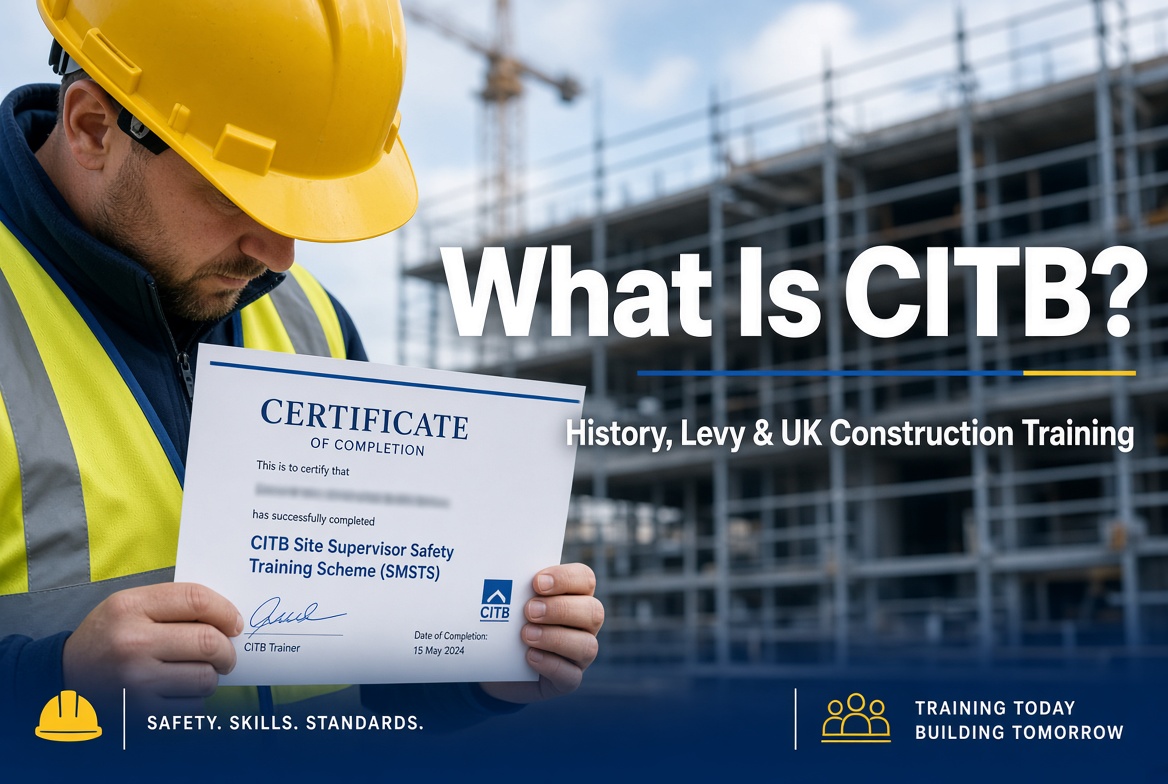
Many people meet CITB through the Site Safety Plus (SSP) scheme. The courses range from the one-day Health and Safety Awareness course up to the five-day Site Management Safety Training Scheme. The best-known are SMSTS for site managers and SSSTS for supervisors. Training providers typically run SSSTS over two days with a one-day refresher, and SMSTS over five days with a two-day refresher. The scheme also includes Temporary Works courses and the Site Environmental Awareness Training Scheme (SEATS). The Temporary Works Supervisor and Coordinator courses carry a renewable five-year certificate. Site Safety Plus (SSP) courses +2
Why CITB matters to site teams
For supervisors, managers and small contractors, CITB shapes the training you take, the standards your employer works to and, through the levy, part of your business costs. Knowing how the system works helps you plan renewals, claim the funding you are entitled to and make sure your certificates stay valid.
Staying on top of certificates, refresher dates and site records is a job in itself. That is where a digital assistant such as KaelSite can take the admin off your plate, so you can concentrate on running a safe site.
References
- CITB, “Our story”: https://www.citb.co.uk/about-us/our-story
- CITB, “What we do”: https://www.citb.co.uk/about-us/jobs-at-citb/what-we-do
- CITB, “History”: https://www.citb.co.uk/about-citb/What-we-do/history
- CITB, “Site Safety Plus (SSP) courses”: https://www.citb.co.uk/training-and-courses/site-safety-plus/
- Designing Buildings Wiki, “Construction Industry Training Board (CITB)”: https://www.designingbuildings.co.uk/wiki/Construction_Industry_Training_Board_CITB
- GTG Training, “CITB Site Safety Plus courses”: https://gtg.co.uk/training-courses/construction/site-safety-plus/
- Essential Site Skills, “What is the Construction Industry Training Board?”: https://essentialsiteskills.co.uk/blog/post/what-construction-industry-training-board
- CST Training, “CITB Site Safety Plus: Courses and Benefits”: https://www.csttraining.co.uk/?p=26174

Comments (0)
Add a Comment
No comments yet. Be the first to comment!