Demolition: Construction Work Items, Site Inspections and Compliance
Demolition projects require careful planning, controlled sequencing and effective site supervision. Whether a team is demolishing an entire building, removing selected structural elements or dismantling an existing facility before redevelopment, inspections and reporting help maintain oversight of changing site conditions and work activities.
Unlike many new-build projects, demolition progressively changes the structure being worked on. Removing a wall, floor, roof or supporting element can affect the stability of the remaining building. Hidden services, hazardous materials, neighbouring properties and changing exclusion zones can introduce additional risks as the work progresses.
For UK construction teams, a structured inspection and reporting process helps capture site observations, document defects, communicate issues and maintain a record of completed checks.
KaelSite provides digital inspection and reporting workflows for construction projects. Its demolition catalogue contains 18 work items and 72 inspection links. These are KaelSite-specific catalogue figures: inspection links associate work items with inspections and do not represent 72 unique inspection types or a mandatory checklist for every demolition project. Explore the full construction project types guide.
What does demolition work involve?
Demolition can range from the complete removal of a building to partial demolition, structural dismantling or the removal of specific elements during refurbishment. The appropriate approach depends on the structure, its condition, its surroundings and the planned redevelopment.
Typical demolition-related activities may include:
-
Pre-demolition surveys and structural assessments.
-
Identification and isolation of services.
-
Asbestos surveys and management of hazardous materials.
-
Installation and inspection of temporary supports.
-
Establishment of exclusion zones and controlled access.
-
Removal of non-structural and structural elements.
-
Dust, noise, vibration and debris management.
-
Segregation, handling and removal of demolition waste.
-
Final clearance, inspections and handover records.
These activities are illustrative examples, not a verified inventory of KaelSite's catalogue entries or a prescribed sequence for every project. The actual method and order of work must be established for the individual site by competent people.
Key inspection areas for demolition projects
1. Pre-demolition surveys and structural assessment
Before demolition starts, the project team needs sufficient information about the building, its construction, condition and previous alterations. The structural form and existing load paths affect how the building can be dismantled safely.
A competent person should assess the structure before work that could affect its stability. Depending on the project, the assessment may consider:
-
Building age, construction type and previous use.
-
Structural alterations and changes to load-bearing elements.
-
Existing damage, deterioration and signs of instability.
-
Nearby buildings, roads, boundaries and public areas.
-
Below-ground and overhead services.
-
Potentially unstable elements and unknown structural conditions.
The findings should inform the demolition method and sequence, temporary support arrangements and controls for people outside the immediate work area.
Where the structure differs from the available drawings or unexpected instability is identified, the team should obtain appropriate technical advice before continuing affected work.
The HSE's guidance on demolition explains the importance of structural information, competent planning and a documented demolition method.
2. Services isolation and disconnection
Live electricity, gas, water, telecommunications, drainage and other services can create serious hazards during demolition. Services may enter the building underground, overhead or through adjoining properties, and not all routes will be immediately visible.
Inspection and reporting arrangements may cover:
-
Identification of known service routes and connection points.
-
Confirmation of required isolation and disconnection arrangements.
-
Identification and marking of services that must remain operational.
-
Protection of retained services and neighbouring properties.
-
Records of relevant permits, confirmations and specialist work.
-
Reassessment where unexpected services are discovered.
The responsible utility providers and competent specialists should be involved where required. A visual site check alone does not prove that a service has been safely isolated.
Any unexpected live service should be reported and managed through the project's safe system of work before affected activities continue.
3. Asbestos and other hazardous materials
Buildings undergoing demolition may contain asbestos-containing materials, particularly where they were constructed or refurbished before asbestos use was prohibited in new construction. Other hazardous substances may also be present depending on the building's former use and materials.
A suitable refurbishment or demolition asbestos survey must be completed by a competent surveyor where required. For demolition, the survey should identify asbestos-containing materials within the building as far as reasonably practicable so that appropriate removal and control arrangements can be made before structural demolition begins.
Relevant records may include:
-
Availability and scope of the appropriate survey.
-
Locations of identified or presumed hazardous materials.
-
Removal arrangements and relevant contractor documentation.
-
Required clearance or handover evidence.
-
Site access restrictions and communication of hazards.
-
Actions taken when previously unidentified materials are encountered.
If a material suspected of containing asbestos is discovered unexpectedly, work that could disturb it should stop and the matter should be referred to the appropriate responsible person. Workers should not sample or remove suspected asbestos themselves unless they are competent and authorised to undertake the specific work.
See the HSE's guidance on refurbishment and demolition asbestos surveys for further information.
4. Demolition sequence and structural stability
The demolition sequence should be based on the structural assessment and the agreed method of work. The team must understand how the building remains stable at each stage, not just how it was designed to stand when complete.
Depending on the structure and method, inspection records may cover:
-
Confirmation that work is proceeding in the approved sequence.
-
Removal of specified elements before subsequent operations.
-
Temporary support and restraint arrangements.
-
Condition of retained structural elements.
-
Accumulation of debris or materials that could affect stability.
-
Changes to the structure that require reassessment.
-
Hold points and authorisations before progressing.
Demolition should be planned and carried out by competent people to prevent uncontrolled collapse. Where site conditions or the structure change, the method may need to be reviewed before work continues.
Inspection records help document what has been checked, but they do not replace engineering assessment, competent supervision or formal authorisation where these are required.
5. Temporary works, exclusion zones and access control
Demolition may require temporary supports, façade retention, propping, scaffolding, edge protection, barriers or other temporary arrangements. Their purpose and design must be suitable for the actual work and foreseeable loads.
Inspection and reporting may cover:
-
Installation against the approved design.
-
Condition of props, braces, connections and supports.
-
Required checks before loading or use.
-
Changes to the demolition sequence or loading conditions.
-
Maintenance of exclusion zones and restricted areas.
-
Safe access routes for workers and authorised visitors.
-
Protection of pedestrians, neighbouring buildings and public areas.
Exclusion zones may need to change as the demolition progresses. The size and location of controlled areas should reflect the demolition method, potential debris travel, surrounding structures and site constraints.
Standard scaffolding should not be assumed to provide structural support or make an otherwise unsafe demolition method acceptable. Any supporting function must be specifically designed for that purpose.
6. Dust, noise, vibration and debris management
Demolition can generate airborne dust, noise, vibration and falling debris. These can affect workers, neighbouring occupants, nearby structures and members of the public.
Depending on the site and method, records may cover:
-
Dust suppression arrangements and their operation.
-
Controls for cutting, breaking and material handling.
-
Noise and vibration monitoring where specified.
-
Condition checks around sensitive neighbouring structures.
-
Debris containment and housekeeping.
-
Safe plant movements and segregation of people from machinery.
-
Complaints, incidents, monitoring results and corrective actions.
The appropriate controls depend on the material, equipment, demolition method and surrounding environment. Where monitoring or trigger levels are specified, results should be reviewed against the project's procedure and escalated when necessary.
Good reporting helps establish when an issue occurred, which controls were in place and what corrective action followed.
7. Plant, lifting operations and work at height
Mechanical demolition may involve excavators, breakers, cutting equipment, lifting operations and other specialist plant. Manual dismantling may also involve working at height or accessing partially demolished structures.
Inspection requirements should be established from the work plan, risk assessment, equipment requirements and applicable regulations.
Relevant records may include:
-
Pre-use checks and condition of plant.
-
Operator competence and access authorisations.
-
Safe operating areas and ground conditions.
-
Lifting plans, equipment records and required examinations.
-
Working platforms, edge protection and access arrangements.
-
Segregation between plant, workers and delivery vehicles.
-
Defects, restrictions and actions required before equipment is used.
Equipment-specific statutory inspection and examination requirements should be managed through the appropriate processes. A general site inspection form should not be treated as a substitute for a required thorough examination or specialist inspection.
8. Waste segregation, site clearance and handover
Demolition generates materials that may need to be segregated, reused, recycled or disposed of through appropriate routes. The project should identify hazardous waste and ensure that materials are handled by suitable contractors.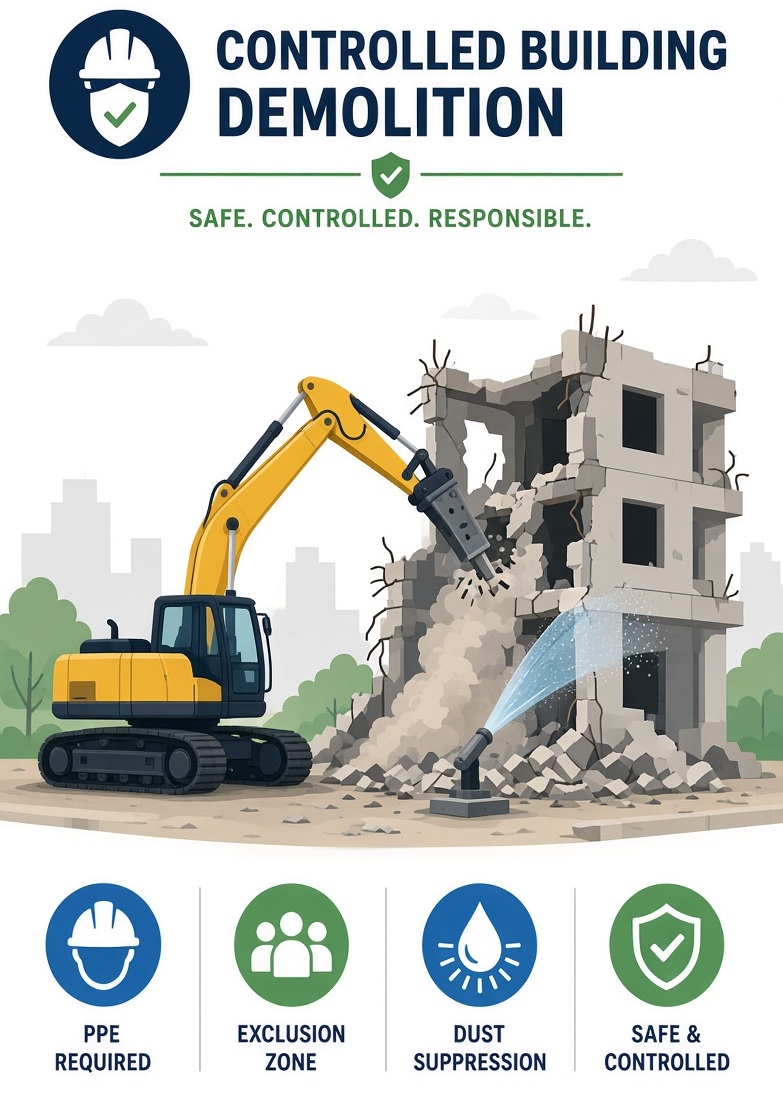
Inspection and reporting activities may include:
-
Segregation of waste streams.
-
Safe storage and handling of materials.
-
Removal of hazardous materials through appropriate arrangements.
-
Housekeeping and removal of debris from access routes.
-
Checks of retained structures and remaining services.
-
Recording of outstanding defects and incomplete work.
-
Handover documentation and relevant waste records.
The completion criteria will depend on whether the project involves full demolition, partial demolition or preparation for the next construction phase. The team should clearly record which areas are complete, which structures or services remain and what restrictions continue to apply.
UK compliance considerations for demolition
Demolition requirements depend on the work, the site, the building and the UK jurisdiction. Project teams should identify the applicable legislation, notifications, approvals and technical requirements before starting work.
Construction (Design and Management) Regulations 2015
The CDM Regulations 2015 apply to demolition work within their scope. They establish duties for clients, designers, principal designers, principal contractors and contractors, according to their roles and the circumstances of the project.
Relevant considerations include pre-construction information, planning and managing risks, coordination between dutyholders, competence, safe systems of work and the protection of workers and others who could be affected.
Inspection and reporting workflows can support communication and evidence of site checks, but they do not replace the dutyholders' responsibilities under CDM.
Demolition notification and building control
In England and Wales, demolition may require advance notice to the local authority under the applicable building control legislation. HSE guidance states that notice is usually required at least six weeks before demolition begins. Requirements, exemptions and processes should be confirmed with the relevant local authority before the project is scheduled.
Other approvals may be needed depending on the location and circumstances, including requirements relating to roads, pavements, scaffolding, traffic management, planning or protected structures.
Do not assume that an internal demolition checklist satisfies notification or approval requirements.
Asbestos and hazardous substances
The Control of Asbestos Regulations 2012 and other relevant health and safety requirements may apply where asbestos is present or suspected. The project team should establish what surveys, removal arrangements, contractor competence, controls and records are required before demolition work begins.
Hazardous materials must be identified and managed through suitable procedures. Where the building's history or survey information is incomplete, the team should resolve the uncertainty before undertaking work that could expose people to hazardous substances.
Structural stability and temporary works
Demolition and dismantling should be planned and carried out by competent people to prevent uncontrolled collapse. Structural surveys, temporary works designs, work sequences and inspection hold points should be appropriate to the specific structure and demolition method.
The HSE's structural stability guidance provides further information on planning alterations, demolition and dismantling safely.
Environmental and waste requirements
Dust, noise, vibration, waste handling and potential pollution should be considered alongside worker safety. Environmental permits, waste documentation and local restrictions may apply depending on the activities and materials involved.
Project teams should confirm the requirements relevant to their site rather than relying on a generic list of controls.
Common demolition inspection and reporting challenges
Demolition conditions can change quickly as structural elements are removed and previously hidden features are exposed. A reliable reporting process helps teams respond to these changes without losing sight of the approved method and outstanding actions.
Common challenges include:
-
Changing structural conditions: Removing one element may affect the stability of others.
-
Hidden hazards: Services or hazardous materials may not be identified by initial visual checks.
-
Time-critical hold points: Work may need to pause for an inspection, technical decision or authorisation.
-
Multiple contractors: Responsibilities and evidence can be distributed across demolition, utility, asbestos and waste contractors.
-
Changing exclusion zones: Work areas and safe access routes may need to be revised as demolition advances.
-
Incomplete close-out: Recording a defect does not demonstrate that it has been resolved.
-
Scattered records: Paper forms, messages and photographs can make it difficult to assemble a reliable project history.
A consistent digital workflow can help site teams capture observations, attach supporting evidence, allocate follow-up actions and retrieve records when required.
How KaelSite supports demolition inspection workflows
KaelSite is a mobile-first, offline-first compliance app for UK construction teams. Its demolition catalogue contains 18 work items and 72 inspection links, providing a project-specific starting point for organising inspection and reporting workflows.
Teams can use KaelSite to help:
-
Record site observations and inspection findings.
-
Attach photographs and supporting evidence to reports.
-
Document defects and outstanding actions.
-
Organise inspection information by project and work activity.
-
Keep reporting records accessible to relevant project stakeholders.
-
Support follow-up and close-out processes.
Because demolition sites may have unreliable connectivity, offline-first workflows can be useful when teams need to capture information away from a stable internet connection.
Core inspection and reporting workflows are available on mobile and web. Some advanced features, including full Report Editing and AI Report Drafting, are available on the web only.
KaelSite supports inspection record keeping and reporting. It does not replace a competent demolition contractor, structural engineer, asbestos specialist, statutory inspection, required notification or project-specific safe system of work.
Building a reliable demolition inspection process
A practical starting point is to map the demolition sequence against the structural assessment, approved method of work, risk assessments and inspection requirements.
For each stage, the team should establish:
-
What needs to be checked before work proceeds.
-
Who is responsible for completing and reviewing the check.
-
What evidence must be recorded.
-
Which conditions require work to stop or be reassessed.
-
How defects and outstanding actions will be tracked to closure.
For example, a project may organise records around pre-demolition surveys, service isolation, hazardous-material removal, temporary support, structural dismantling, environmental controls and final clearance. The exact stages depend on the project and should not be copied blindly from another site.
Inspection findings should be recorded promptly, with clear descriptions, relevant photographs and an identified action where needed. Any significant change to the structure, unexpected hazard or concern about stability should be escalated through the agreed project procedure.
Explore related construction project types
Demolition is often the first phase of a wider redevelopment, refurbishment or structural alteration project. These related guides provide additional context:
Frequently asked questions
What should be inspected before demolition starts?
Pre-start checks may cover structural surveys, the demolition method and sequence, service isolation, asbestos information, temporary works, exclusion zones and site access. The actual requirements depend on the structure, demolition method and applicable approvals.
Is a structural survey required before demolition?
A competent structural assessment is important for planning demolition safely, particularly where structural stability could be affected. The scope and level of assessment should reflect the structure, its condition, the proposed work and the applicable requirements.
Does every demolition project require an asbestos survey?
The survey requirements depend on the building, proposed work and applicable asbestos regulations. A suitable refurbishment or demolition survey is required where applicable before work that could disturb asbestos-containing materials. The team should establish the correct survey scope with a competent surveyor before demolition begins.
What should a demolition inspection report include?
Depending on the inspection, a report may include the location, date, work stage, observations, photographs, defects, required actions and follow-up status. It should also identify relevant approvals or hold points where applicable. The project inspection plan determines the required information.
How many work items and inspection links does KaelSite include for demolition?
KaelSite's catalogue includes 18 work items and 72 inspection links for Demolition. These are catalogue associations between work items and inspections, not 72 unique inspection types or a universal set of mandatory checks.
Conclusion
Demolition requires a controlled approach to structural stability, service isolation, hazardous materials, temporary works, environmental controls and waste management. Clear inspection responsibilities and reliable reporting help construction teams identify issues, communicate changes and maintain traceable records throughout the demolition sequence.
KaelSite supports digital inspection and reporting workflows for demolition and other UK construction project types. By organising site findings, photographs and follow-up actions, teams can make inspection information easier to record, review and retrieve throughout the project.

Comments (0)
Add a Comment
No comments yet. Be the first to comment!