Temporary Works Inspection Checklist: What Should a TWS Check?
Temporary works inspections are an important part of controlling temporary works on a construction project.
If you are a Temporary Works Supervisor (TWS), you may be responsible for carrying out or supporting inspections as part of your project's temporary works arrangements.
But what should you actually check?
What should you record?
What happens if you find a defect?
And can you use a mobile app instead of paper inspection forms?
This guide provides a practical overview of temporary works inspections and explains how a digital inspection workflow can help supervisors record findings, capture evidence and track corrective actions.
Important: There is no single inspection checklist that is suitable for every temporary works item. The inspection requirements should be based on the specific temporary works, relevant design information, project procedures, risk assessment and the responsibilities assigned to the competent people involved.
What is a temporary works inspection?
A temporary works inspection is a check carried out to determine whether temporary works are in the required condition and are being used or maintained in accordance with the relevant project arrangements.
Depending on the type of temporary works, an inspection may consider:
-
Installation
-
Condition
-
Stability
-
Supports
-
Connections
-
Bracing
-
Components
-
Loading
-
Damage
-
Changes
-
Ground conditions
-
Site conditions
-
Signs of movement
-
Deterioration
-
Unauthorised alterations
The exact inspection requirements will vary considerably.
For example, inspecting excavation support is very different from inspecting formwork or temporary propping.
That is why a generic checklist should be treated as a starting point rather than a replacement for project-specific requirements.
Who carries out temporary works inspections?
The answer depends on the project's temporary works procedure and the responsibilities assigned to individuals.
A Temporary Works Supervisor (TWS) may have inspection and supervision responsibilities.
The Temporary Works Coordinator (TWC) has a wider coordination and management role.
Other competent people may also be involved depending on the temporary works and project arrangements.
The important question is not simply:
"Who has a TWS certificate?"
It is:
"Who has been appropriately appointed and is competent to carry out this particular inspection?"
Training, education and experience all contribute to competence.
What should a TWS check?
There is no universal TWS inspection checklist that can safely be applied to every temporary works system.
However, a practical inspection can be structured around several key areas.
1. Correct temporary works
First, confirm that you are inspecting the correct temporary works item.
Check:
This sounds simple, but on a large project there may be many temporary works schemes operating at the same time.
Clear identification prevents the inspection from being attached to the wrong item.
2. Installation
Consider whether the temporary works have been installed in accordance with the relevant information and project arrangements.
Depending on the system, this could involve checking:
-
Components
-
Connections
-
Supports
-
Bracing
-
Fixings
-
Alignment
-
Stability
-
Required configuration
Do not make technical assumptions outside your competence.
If something does not appear correct, escalate it through the project's temporary works procedure.
3. Condition
Look for visible signs of damage or deterioration.
Potential observations could include:
-
Bent components
-
Cracks
-
Corrosion
-
Damaged connections
-
Missing components
-
Loose components
-
Deformation
-
Impact damage
-
Excessive wear
The appropriate response depends on the temporary works design and project procedure.
4. Stability
Consider whether there are visible conditions that could affect stability.
For example:
If there is a concern about structural stability, it should be escalated immediately through the appropriate process.
5. Loading
Temporary works are often designed for specific loads and conditions.
Check whether there are visible signs of:
-
Unexpected loading
-
Excessive loading
-
Materials stored against temporary works
-
Plant operating too close
-
Changed loading conditions
Never assume that because a temporary structure looks strong, it can accept additional loading.
Loading requirements should come from the relevant design and project arrangements.
6. Changes
One of the most important things to look for is whether the temporary works have been changed.
Examples might include:
Unauthorised modifications can change the behaviour of temporary works.
Any significant change should be dealt with through the appropriate project procedure.
7. Surrounding conditions
Temporary works do not exist in isolation.
Changes around them can affect their performance.
Consider relevant changes such as:
Again, the appropriate checks depend on the specific temporary works.
Temporary works inspection checklist example
A simple inspection structure might look like this:
| Inspection area |
Check |
Result |
Evidence |
Action |
| Identification |
Correct temporary works item |
Pass |
— |
— |
| Installation |
Components correctly installed |
Pass |
Photo |
— |
| Condition |
No visible damage |
Pass |
Photo |
— |
| Stability |
Supports/bracing satisfactory |
Pass |
Photo |
— |
| Loading |
No unexpected loading |
Pass |
Photo |
— |
| Changes |
No unauthorised modifications |
Pass |
Photo |
— |
| Surroundings |
No relevant adverse changes |
Pass |
Photo |
— |
| Documentation |
Relevant information available |
Pass |
— |
— |
This is an illustrative example, not a universal BS 5975 inspection checklist.
Your actual inspection should reflect the temporary works being inspected and your project's procedures.
What should you record during an inspection?
A good inspection record should provide enough information for someone else to understand what was inspected, when it was inspected and what was found.
Depending on the project, this could include:
The exact requirements should be determined by the project.
Why are photographs useful?
Photos can provide useful evidence of site conditions at the time of inspection.
For example, a photograph can help show:
Photos should support the written inspection record rather than replace it.
A photo without context may not explain:
What is wrong?
Where is it?
Why does it matter?
What action is required?
That is why photographs work best when connected to the relevant inspection item or issue.
What happens when a temporary works inspection fails?
A failed inspection should not simply be marked FAIL and forgotten.
A practical workflow is:
Inspect
↓
Identify problem
↓
Record finding
↓
Capture evidence
↓
Communicate
↓
Assess
↓
Take appropriate action
↓
Follow up
↓
Close
The exact process depends on the severity and nature of the finding.
Some issues may require immediate action.
Others may require assessment by a competent person before any change is made.
The TWS should follow the project's established escalation and temporary works procedures.
What should you do if you find a serious defect?
If an inspection identifies a serious concern, do not attempt to solve a technical temporary works problem outside your competence.
Follow the project's established procedure.
Depending on the circumstances, this may involve:
-
Making the area safe
-
Restricting access
-
Preventing use
-
Informing the TWC
-
Escalating to the appropriate engineer or competent person
-
Recording the issue
-
Following the required corrective action process
-
Carrying out a further inspection when instructed or required
The correct response depends on the temporary works, the nature of the defect and the project's procedures.
What is a temporary works inspection record?
A temporary works inspection record is the documented evidence of an inspection.
It can show:
What was inspected
When it was inspected
Who inspected it
What was found
What evidence was captured
What action was required
Whether follow-up was necessary
A useful inspection record should be easy to understand later.
Imagine a project manager looking at the record six months after the inspection.
Could they understand exactly what happened?
If not, the record may need more detail.
Temporary works inspection vs temporary works register
These are two different things.
Temporary Works Register
The register provides an overview of the temporary works items on a project.
Inspection Record
The inspection record contains the detailed findings of an individual inspection.
For example:
Temporary Works Register
TW-014 — Temporary propping — Inspection required
Then:
Inspection Record
TW-014 inspected on 15 October. Findings recorded. Photographs attached. Issue raised regarding identified condition.
The inspection can then be linked back to the relevant temporary works item.
This creates a much clearer audit trail.
How often should temporary works be inspected?
There is no single inspection frequency that applies to every temporary works item.
The required inspection regime depends on factors such as:
Some temporary works may require inspections at defined stages.
Other situations may require additional inspections following events such as:
The inspection regime should therefore be established by the appropriate competent people and project procedures.
Should temporary works be inspected after bad weather?
Potentially, yes.
The need for additional inspection depends on the temporary works and the effect of the weather or other event.
For example, severe weather may affect:
-
Stability
-
Ground conditions
-
Excavations
-
Temporary access
-
Temporary structures
-
Water levels
-
Components
Your project procedure should identify when additional inspections are required.
The important principle is:
Do not wait for the next scheduled inspection if a significant event may have affected the temporary works.
Follow the project's procedure and escalate concerns appropriately.
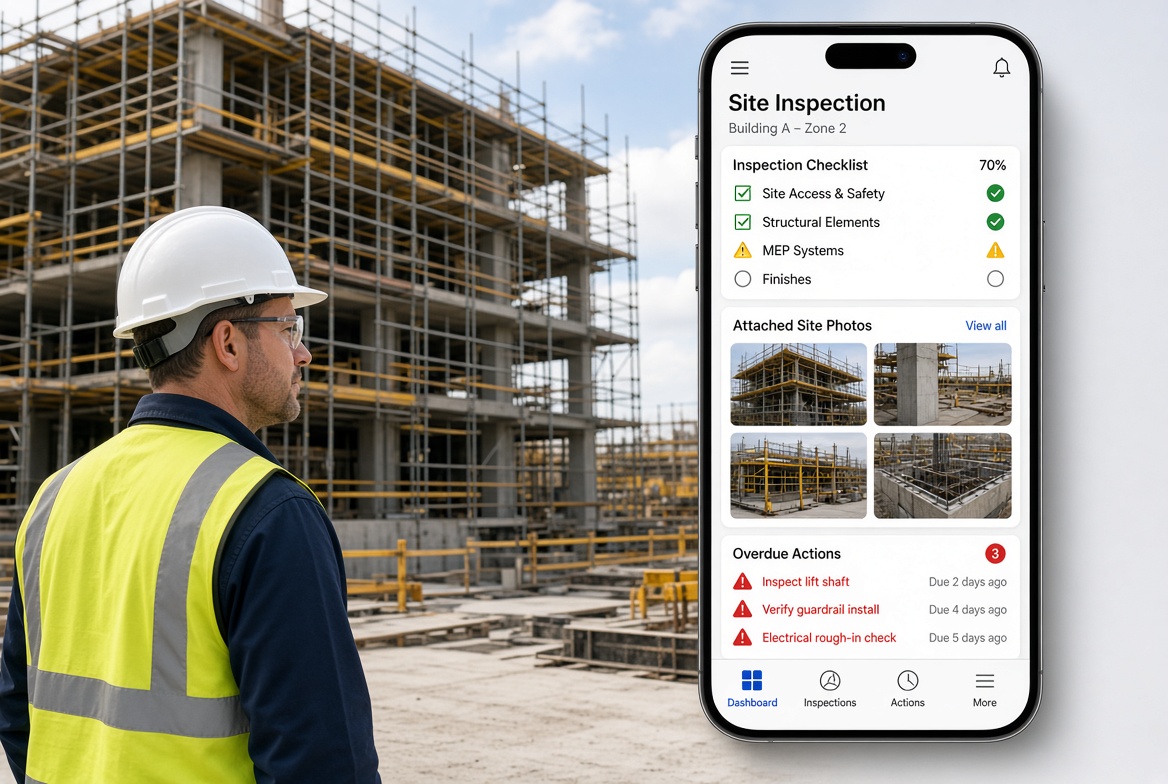
Can temporary works inspections be done on a phone?
Yes.
A mobile inspection app can allow supervisors to complete inspections directly from site.
Instead of:
Print checklist → visit site → write notes → take separate photos → return to office → scan paperwork → email report
the workflow can become:
Open inspection → inspect → record → photograph → report → assign action → submit
This can significantly reduce administration.
What is the best temporary works inspection app?
The best app depends on the requirements of your organisation and projects.
However, a useful temporary works inspection app should make the actual site workflow simple.
Look for:
Mobile-first design
The inspection should be easy to complete on a phone.
Custom checklists
Different temporary works require different inspection criteria.
Photo capture
Evidence should be easy to attach.
Issue reporting
Defects should be reportable from the inspection itself.
Corrective actions
Actions should have clear responsibility and status.
Due dates
Overdue actions should be visible.
Offline working
Useful where signal is poor.
Inspection history
Previous inspections should be easy to find.
Reports
The system should make it easy to produce useful records.
Search
You should be able to quickly find a temporary works item or previous inspection.
Why offline inspections matter on construction sites
Construction sites are not always connected.
You may be working:
An inspection app that only works with a strong internet connection can become frustrating.
Offline functionality allows site teams to continue recording information and synchronise it when connectivity becomes available.
For mobile-first construction software, this is not simply a nice feature.
It can be essential to the workflow.
How KaelSite can help with temporary works inspections
KaelSite is designed to make construction inspections easier to complete and manage from the field.
For a temporary works inspection, a typical workflow could be:
1. Select the project
Open the relevant project from your mobile device.
2. Select the temporary works inspection
Choose the relevant inspection checklist.
3. Complete the inspection
Work through the checks required by the project's procedures.
4. Add notes
Record relevant observations.
5. Capture photographs
Add visual evidence directly from site.
6. Create an issue
If a defect or concern is identified, create an issue from the inspection.
7. Assign corrective action
Where appropriate, assign the action to the relevant person and set a due date.
8. Track the issue
Monitor progress until the appropriate action has been completed.
9. Follow up
Carry out a further inspection when required.
10. Keep the record
The inspection, evidence, issue and action history remain connected.
This can make it easier for TWSs and managers to see not just what was inspected, but what happened afterwards.
KaelSite is a support tool. It does not replace competent people, engineering judgement, design, project procedures, approvals or required sign-off.
Paper vs digital temporary works inspections
| Feature |
Paper |
Digital |
| Site inspection |
Yes |
Yes |
| Photo evidence |
Separate process |
Integrated |
| Issue tracking |
Manual |
Connected |
| Corrective actions |
Manual |
Trackable |
| Due dates |
Manual |
Automated visibility |
| Search history |
Difficult |
Easier |
| Reports |
Manual |
Faster |
| Offline work |
Yes |
Depends on app |
| Multiple projects |
Difficult |
Easier |
| Real-time visibility |
Limited |
Better |
Digital is not automatically better.
The system still needs to be designed around the actual construction workflow.
A complicated app can be just as frustrating as complicated paperwork.
The goal is simple site reporting with reliable records.
Temporary works inspection checklist for supervisors
Before finishing an inspection, consider whether you have:
-
Identified the correct temporary works
-
Confirmed the location
-
Used the appropriate inspection criteria
-
Checked relevant visible conditions
-
Considered changes
-
Considered surrounding conditions
-
Recorded findings clearly
-
Captured useful photographs
-
Reported defects
-
Escalated concerns where necessary
-
Assigned corrective actions where appropriate
-
Set relevant due dates
-
Identified follow-up requirements
-
Submitted the inspection record
Again, this is a practical checklist structure, not a replacement for the project's specific temporary works inspection requirements.
Temporary works inspection mistakes to avoid
Using the same checklist for everything
Different temporary works have different risks and inspection requirements.
Treating "PASS" as enough information
A simple pass/fail result may not provide enough context.
Taking photos without notes
A photograph should be connected to a meaningful finding where appropriate.
Recording defects but not actions
An issue without a clear next step can remain unresolved.
Closing actions without verification
Depending on the project procedure, corrective action may need to be checked before the issue is considered closed.
Making technical decisions outside your competence
If a defect requires engineering assessment, escalate it to the appropriate competent person.
Losing inspection history
Temporary works records should be organised so relevant information can be found when required.
Temporary works inspection and competence
A checklist cannot make someone competent.
An app cannot make someone competent.
A certificate alone does not automatically make someone competent.
Competence involves the appropriate combination of knowledge, training and experience for the role and work being undertaken.
CITB's current TWS training information makes this distinction explicitly: completing the TWSTC course does not by itself demonstrate competence as a Temporary Works Supervisor.
Training should therefore be combined with appropriate experience, project procedures and organisational competence arrangements.
Frequently asked questions
What is a temporary works inspection?
It is an inspection of temporary works to determine whether they are in the required condition and being managed and used in accordance with the relevant project arrangements.
Who should inspect temporary works?
The person responsible for inspection should be appropriately appointed and competent for the particular temporary works and inspection. The project's Temporary Works Procedure should define the responsibilities.
What does a TWS check?
A TWS may check relevant aspects such as installation, condition, stability, supports, bracing, loading, changes and surrounding conditions. The exact checklist depends on the temporary works and project requirements.
How often should temporary works be inspected?
There is no universal frequency. The inspection regime should be established according to the temporary works, risks, design information, project procedures and relevant requirements.
Should temporary works be inspected after bad weather?
An additional inspection may be appropriate where weather or another event could have affected the temporary works. Follow the project's procedure.
What happens if a temporary works inspection fails?
The finding should be recorded and communicated, with appropriate action taken through the project's temporary works process. A further inspection may be required.
Can a TWS stop work?
The authority of a TWS to stop or restrict work depends on the project's organisational arrangements and delegated authority. Where a serious concern exists, the appropriate escalation process should be followed immediately.
Do temporary works inspections need photographs?
Photographs may be useful evidence, but the exact documentation requirements depend on the project's procedures and the type of inspection.
Can I use a temporary works inspection app?
Yes. Digital inspection software can help with checklists, photographs, issue reporting, corrective actions, follow-up inspections and records.
Is there a BS 5975 inspection checklist?
There are inspection templates and guidance associated with temporary works management, including CITB's published temporary works inspection checklist and record. However, there is no single generic checklist that should replace project-specific inspection requirements.
Can KaelSite replace a temporary works inspection?
No.
KaelSite can provide the digital workflow and records used to support an inspection, but the inspection itself must be carried out by the appropriate competent person following the project's requirements.
Final thoughts
A good temporary works inspection is not simply about ticking boxes.
It is about answering four questions:
What did we inspect?
What did we find?
What needs to happen?
Has it been dealt with appropriately?
That is why a strong inspection workflow connects:
Inspection → Evidence → Issue → Action → Follow-up → Record
For TWSs, this can make site inspections easier to manage.
For TWC teams, it provides better visibility.
For project managers, it can make outstanding issues easier to identify.
And for the wider construction team, it can reduce the risk of important information getting lost between paper forms, emails and spreadsheets.
KaelSite brings these workflows together in a mobile-first construction platform, helping teams complete inspections, capture evidence, report issues, assign corrective actions and maintain searchable site records.
The checklist is only the beginning.
The real value comes from what happens after the checklist is completed.

Comments (0)
Add a Comment
No comments yet. Be the first to comment!