Why the TWS/TWC split exists
Temporary works, falsework, formwork, propping, excavation support, temporary access, exist only to support the permanent structure while it's being built. They're removed once they've done their job, which is exactly why they get treated casually on too many sites. That's a mistake: temporary works failures have caused some of the most serious incidents in UK construction history.
BS 5975 was written specifically to close that gap by creating clear, named roles with defined authority. It's not a legal requirement in itself, but the Health and Safety Executive treats it as the recognised standard for meeting the general duties under CDM 2015, so in practice it's the benchmark every principal contractor is judged against.
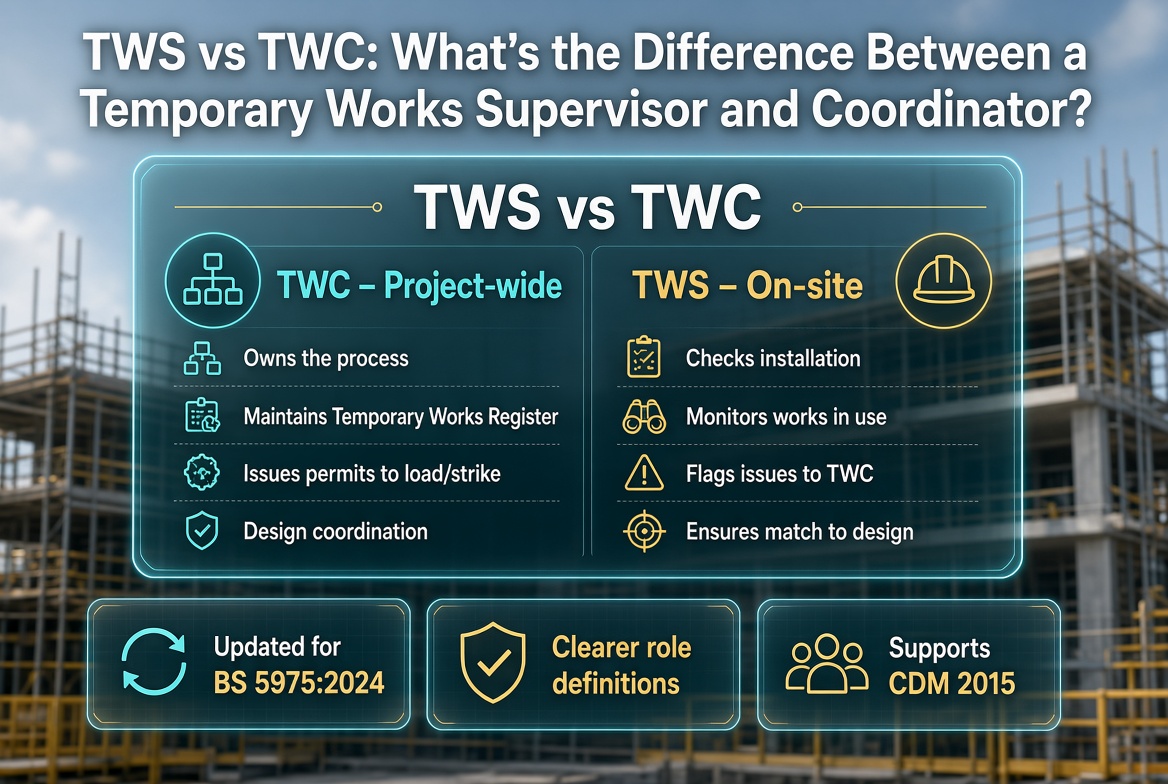
Temporary Works Coordinator (TWC): the project-wide role
The TWC is the person with overall responsibility for the temporary works process on a project, usually a site manager, engineer, or senior supervisor with the experience to sit across the whole lifecycle. Their job is procedural control: making sure every temporary works item is properly designed, independently checked, formally authorised before loading, and tracked through to removal.
Core TWC responsibilities:
- Maintaining the Temporary Works Register for the project
- Appointing and managing designers and checkers
- Issuing permits to load/permits to strike before works are used or removed
- Making sure the design brief matches what's actually being built on site
- Acting as the point of contact between design and site teams
Temporary Works Supervisor (TWS): the on-site role
The TWS supports the coordinator by monitoring installation on the ground. Where the TWC deals with paperwork, authorisation and design intent, the TWS deals with whether what's physically going up matches what was approved.
Core TWS responsibilities:
- Checking installation against the approved drawings
- Spotting deviations, damage, or unauthorised changes before they become a problem
- Flagging issues back to the TWC rather than making judgement calls on design adequacy
- Day-to-day monitoring of works in use
TWS vs TWC at a glance
| |
Temporary Works Coordinator (TWC) |
Temporary Works Supervisor (TWS) |
| Scope |
Whole project |
Individual works on site |
| Focus |
Procedure, authorisation, design coordination |
Physical installation and monitoring |
| Typical background |
Engineer, senior site manager |
Site supervisor, foreman |
| Training |
2-day CITB Site Safety Plus course |
1–2 day course, site-focused |
| Reports to |
Client/principal contractor |
TWC |
Both roles need to be formally appointed and demonstrably competent, you can't just hand someone the title.
What changed with BS 5975:2024
BS 5975 was revised at the end of 2024, split into two parts: BS 5975-1:2024 covering management procedures, and BS 5975-2:2024 covering falsework design and implementation. This replaces the single 2019 edition, and it's worth knowing about even if you're not directly involved in falsework design, because the procedural changes in Part 1 affect every TWC and TWS on site.
The headline changes:
- Sharper role definitions. The Coordinator and Supervisor roles are more tightly defined, reducing the ambiguity that caused overlap and gaps under the 2019 wording.
- Stronger emphasis on the Principal Designer's duties under CDM 2015, tightening accountability for design risk earlier in the process.
- More explicit environmental risk guidance, flooding, ground contamination, and soil erosion are now called out as factors that can compromise temporary works, not just structural loading.
- Clearer expectations on documentation and independent design checks, which is the area enforcement tends to focus on when things go wrong.
If your Temporary Works Register, permit templates, or inspection checklists were built against BS 5975:2019, they're due an update.
Where TWS and TWC responsibilities meet CDM 2015
BS 5975 doesn't exist in isolation, it's the practical mechanism for meeting duties that already sit within CDM 2015. Principal contractors and principal designers are on the hook for planning and monitoring construction health and safety, and enforcement bodies use BS 5975 compliance as the yardstick for whether that duty was met on temporary works specifically. In other words: a missing permit-to-load or an out-of-date Temporary Works Register isn't just a BS 5975 gap, it's a CDM 2015 gap too.
Keeping TWS and TWC roles audit-ready
The roles are only as good as the paper trail behind them. In practice, that means:
- A live Temporary Works Register that's actually kept current, not updated retrospectively
- Permits to load/strike that are issued and signed before work proceeds, with a timestamp
- Inspection records tied to the specific temporary works item, with photo evidence
- Certificates and competency records for anyone appointed as TWC or TWS, with expiry tracking
This is exactly the paperwork that gets requested first in an HSE investigation, and it's usually the first thing that falls behind on a busy site when it's managed on paper or spreadsheets.
KaelSite's Form Studio lets you build a bespoke Temporary Works Register and permit-to-load form matched to BS 5975-1:2024, with offline inspections, photo/geotag evidence, and automatic expiry alerts for TWC and TWS competency certificates, so the compliance trail stays current without anyone chasing it manually.
FAQ
Is a TWC legally required on every project? No, appointing a TWC isn't a standalone legal requirement, but BS 5975 compliance is treated as the recognised benchmark for meeting CDM 2015 duties, so in practice most principal contractors appoint one as standard.
Can the same person be TWS and TWC? On smaller projects it's possible, but the roles need to stay functionally separate, someone checking their own installation work isn't independent oversight. On larger or higher-risk projects they should be different people.
Do TWS and TWC certificates expire? Training certificates are typically valid for around five years, in line with other CITB Site Safety Plus qualifications, so tracking renewal dates matters.
Does BS 5975:2024 replace CDM 2015? No, CDM 2015 remains the legal framework. BS 5975:2024 is the code of practice that shows how temporary works duties under CDM 2015 should be managed in practice.

Comments (0)
Add a Comment
No comments yet. Be the first to comment!