KaelSite
Construction Project Types: Work Items, Inspections and Compliance
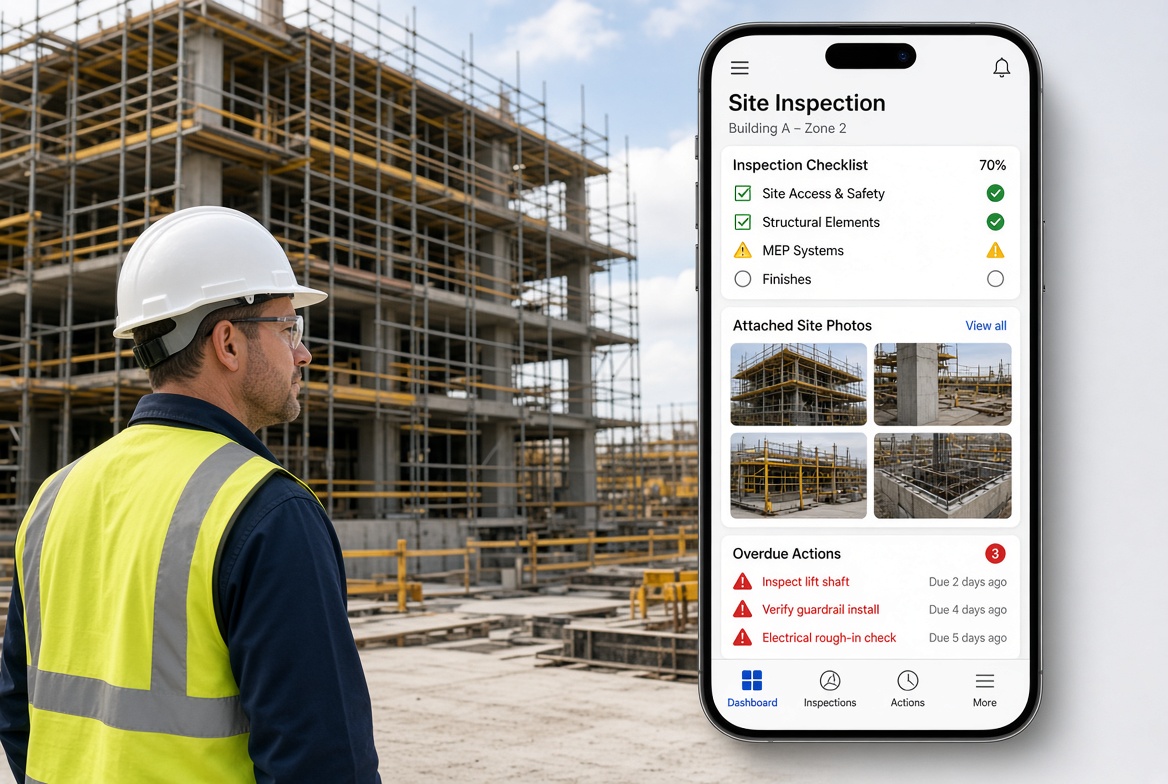
KaelSite’s construction catalog covers 20 project types, 596 work items, 2,345 inspection links and 310 shared inspection types, helping UK construction teams …
Read article KaelSite
kaelsite.com
Educational calculator
Explore how boarded platform area and a uniformly distributed service load combine into a total imposed load. Load classes from BS EN 12811 are shown as guide figures only, this is not scaffold design, TG20 checking or a competent-person assessment.
Read the guide: Scaffold Load Calculator.
Free to use. No registration required.
From the blog
KaelSite
KaelSite’s construction catalog covers 20 project types, 596 work items, 2,345 inspection links and 310 shared inspection types, helping UK construction teams …
Read articleTemporary Work
Temporary works are hard to manage when registers, inspections, photos and actions are scattered across spreadsheets and emails. This guide explains what …
Read articleTemporary Work
BS 5975 is the British Standard code of practice for controlling temporary works. This guide explains the 2024 split into BS 5975-1 …
Read articleNo. This is an educational tool that multiplies platform area by a uniformly distributed load. It does not design scaffolds, check TG20 or system-scaffold data, assess ties, standards, ledgers, boards, foundations or wind, and must not replace a competent person's design, calculations or handover inspection.
Multiply the boarded length by the boarded width. If you have several identical boarded lifts, multiply by the number of platforms for a total boarded area. Real scaffolds often have different boarded widths and loadings on each lift — that needs proper design.
They are guide uniformly distributed service loads used in scaffold standards, from Class 1 (0.75 kN/m²) through Class 6 (6.00 kN/m²). Picking a class in this tool only shows the arithmetic for that pressure × area. It does not certify that your scaffold is that class.
For a uniform load: total imposed load (kN) = load per m² × total boarded area (m²). Working backwards, load per m² = total applied load ÷ area. Concentrated loads, partial boarding and dynamic effects are outside this illustration.
No. Follow NASC TG20 (or the relevant system guidance), the Work at Height Regulations duties, and engage a competent designer or temporary works engineer wherever the scaffold is not a standard compliant configuration. This page is for learning the basic load arithmetic only.
Site teams often talk about load in kilograms of materials. Dividing kilonewtons by g (≈ 9.81) gives a rough kilogram-force equivalent. It is still only an illustration of the uniform load you entered, not a capacity check.
KaelSite