What Is BS 5975? Temporary Works Procedures, TWS and TWC Explained
If you work in construction, you have probably heard of BS 5975.
It is one of the key standards associated with the management and control of temporary works in the UK.
You may also come across terms such as:
-
BS 5975 temporary works
-
BS 5975 TWS
-
BS 5975 TWC
-
Temporary Works Coordinator
-
Temporary Works Supervisor
-
Temporary Works Register
-
Temporary Works Procedure
-
Temporary Works Inspection
-
BS 5975 checklist
-
BS 5975 compliance
But what does BS 5975 actually mean?
What does it say about temporary works?
What are the responsibilities of a TWS and TWC?
And how does BS 5975 relate to the everyday work happening on a construction site?
This guide explains the standard in practical terms and shows how it connects to temporary works management, inspections, registers, records and digital site management.
Important: BS 5975 is a code of practice, not a substitute for project-specific engineering judgement, competent people, legal requirements or the project's own temporary works procedures.
What is BS 5975?
BS 5975 is a British Standard covering temporary works.
The current standard is divided into two parts:
The 2024 revision replaced the previous BS 5975:2019 structure by splitting it into these two parts. BSI published the revised standards in December 2024.
BS 5975-1:2024 focuses on the procedural control and management of temporary works.
BS 5975-2:2024 focuses specifically on falsework design and implementation.
For site supervisors, coordinators and managers, BS 5975-1 is particularly relevant because it addresses the processes used to control temporary works.
What are temporary works?
Temporary works are structures, systems or arrangements used during construction that are not intended to form part of the completed permanent structure.
Examples can include:
-
Temporary propping
-
Falsework
-
Formwork
-
Excavation support
-
Temporary access structures
-
Temporary platforms
-
Temporary support systems
-
Temporary stability measures
-
Temporary structures used during construction
Some temporary works may only exist for a short period.
Others may remain in place for months.
The important point is that temporary does not mean low risk.
A temporary structure can carry significant loads or provide critical support during construction.
That is why temporary works need appropriate planning, design, checking, construction, inspection, monitoring and removal.
See difference between a TWS and TWC
What does BS 5975-1:2024 cover?
BS 5975-1:2024 provides recommendations and guidance for the procedural control of temporary works.
BSI describes it as covering the temporary works process from training and education through to ensuring that temporary works are conceived, designed, specified, constructed, used and dismantled safely and in a controlled manner.
This makes BS 5975 much broader than simply checking a temporary structure.
It is about managing the whole process.
That can include:
Planning
↓
Design
↓
Checking
↓
Approval
↓
Construction
↓
Inspection
↓
Use
↓
Monitoring
↓
Modification
↓
Dismantling
The exact process should be established through the project's temporary works arrangements.
What is a Temporary Works Procedure?
A Temporary Works Procedure (TWP) is the process used by an organisation or project to control temporary works.
It establishes how temporary works are:
-
Identified
-
Classified
-
Designed
-
Checked
-
Approved
-
Constructed
-
Inspected
-
Used
-
Monitored
-
Modified
-
Dismantled
-
Recorded
The procedure should define responsibilities and communication between the people involved.
BS 5975-1:2024 provides recommendations and guidance that can be used when developing these management procedures.
A good Temporary Works Procedure should also be appropriate to the size and complexity of the project.
A small construction project and a major infrastructure project may require very different levels of control.
What is the Temporary Works Coordinator?
The Temporary Works Coordinator (TWC) is a key role within the temporary works management process.
The TWC coordinates the temporary works process and helps ensure that the appropriate procedures are followed.
Depending on the project's arrangements, the TWC may be involved with:
-
Establishing and maintaining the Temporary Works Register
-
Coordinating temporary works designs
-
Coordinating design checks
-
Managing temporary works documentation
-
Coordinating inspections
-
Monitoring the temporary works process
-
Communicating with designers and contractors
-
Managing changes
-
Ensuring relevant records are maintained
-
Coordinating with the Temporary Works Supervisor
The exact responsibilities should be defined by the project's Temporary Works Procedure.
CITB's temporary works training materials currently use BS 5975-1&2:2024 as the relevant standard framework for its TWS and TWC training.
See What Is a TWC? Temporary Works Coordinator Explained
What is the Temporary Works Supervisor?
The Temporary Works Supervisor (TWS) is a site-focused role associated with supervising temporary works.
Depending on the project's arrangements, a TWS may be responsible for activities such as:
-
Supervising temporary works on site
-
Supporting inspections
-
Monitoring temporary works
-
Identifying defects or concerns
-
Reporting problems
-
Checking that site activities follow the relevant procedures
-
Supporting the TWC
-
Recording inspection findings
-
Escalating issues
The TWS does not replace the TWC.
A simple way of thinking about the difference is:
TWC = coordination and management
TWS = supervision and site implementation
However, the exact allocation of responsibilities must come from the project's own arrangements.
See What Is a TWS? Temporary Works Supervisor Explained
See difference between a TWS and TWC
BS 5975 TWS responsibilities
BS 5975 is particularly relevant to TWSs because it provides the framework within which their role operates.
A TWS should understand:
-
Why temporary works need controlled management
-
Their own responsibilities
-
The responsibilities of other people
-
How temporary works are inspected
-
How risks are managed
-
How problems are communicated
-
How records are maintained
-
When concerns need to be escalated
CITB's current TWSTC specifically focuses on helping people with responsibility for supervising temporary works understand the TWS role and the temporary works environment.
See TWS and TWC responsibilities
BS 5975 TWC responsibilities
The TWC has a wider coordination role.
The TWC needs visibility of the temporary works across the project.
This is why the Temporary Works Register is so important.
The register can provide an overview of:
CITB provides temporary works templates including a Temporary Works Register and an inspection checklist and record.
See TWS and TWC responsibilities
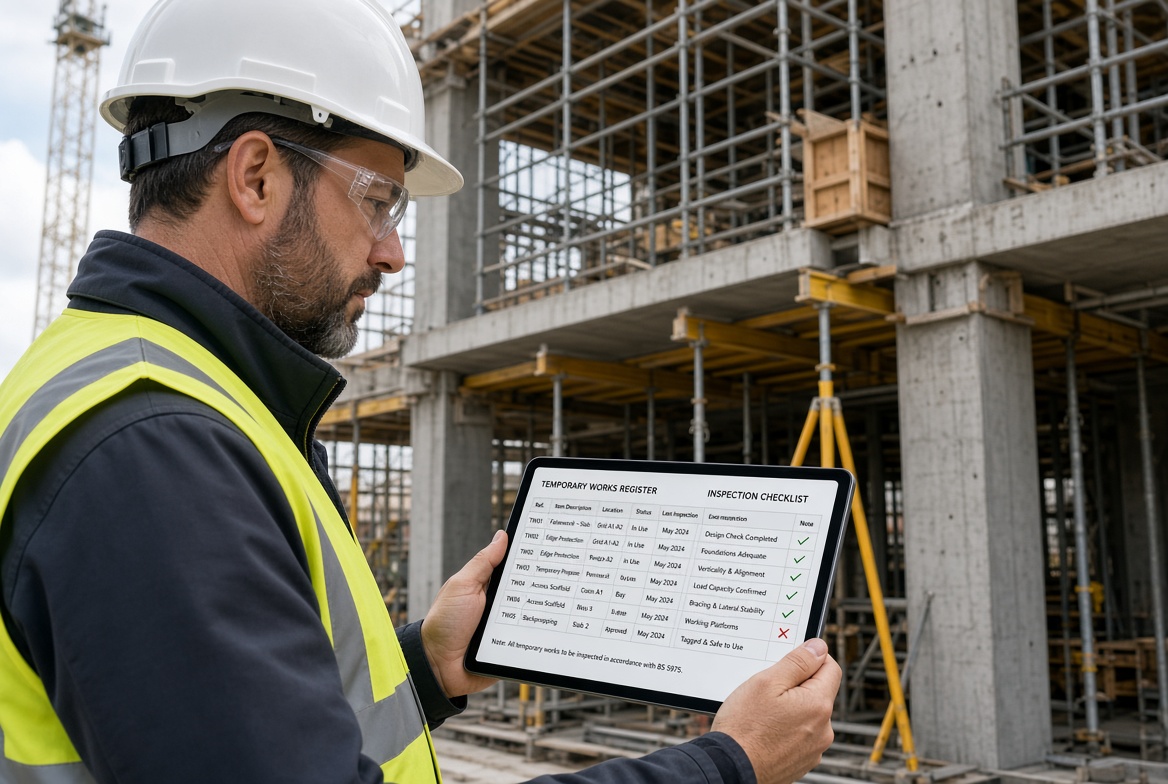
What is a Temporary Works Register?
The Temporary Works Register, or TWR, is used to list and track temporary works.
Think of it as the project's temporary works control centre.
For example:
| Ref |
Temporary Works |
Design |
Check |
Inspection |
Status |
| TW-001 |
Excavation support |
Complete |
Complete |
Required |
Installation |
| TW-002 |
Temporary propping |
Complete |
Complete |
Complete |
In use |
| TW-003 |
Formwork |
In progress |
Pending |
Pending |
Design |
| TW-004 |
Temporary access |
Complete |
Complete |
Complete |
Complete |
This is only an illustrative example.
The information and format required should be determined by the project's Temporary Works Procedure.
Why is the Temporary Works Register important?
Without a central register, it can become difficult to know what temporary works are actually active on a project.
You might have information spread across:
-
Emails
-
Drawings
-
Design documents
-
Inspection sheets
-
RAMS
-
Spreadsheets
-
Paper forms
-
Shared folders
-
Photos
A register brings the temporary works items together.
The question becomes:
"What temporary works do we have, and what stage is each one at?"
That visibility is valuable to the TWC, TWS and project management team.
See temporary works register
What is a BS 5975 inspection?
A BS 5975 inspection should not be thought of as a generic checklist that automatically makes an inspection compliant.
Inspection requirements depend on the temporary works, project procedure and specific arrangements.
An inspection may consider things such as:
-
Condition
-
Installation
-
Components
-
Stability
-
Bracing
-
Connections
-
Supports
-
Ground conditions
-
Loading
-
Changes
-
Damage
-
Site conditions
The appropriate inspection criteria should come from the relevant temporary works information and project procedures.
What happens when an inspection fails?
This is where temporary works management becomes practical.
Suppose a TWS identifies a problem.
The workflow could be:
1. Identify
Something does not appear to meet the required condition.
2. Record
The finding is documented.
3. Capture evidence
Photographs and notes can provide useful evidence.
4. Communicate
The appropriate people are informed.
5. Assess
The issue is considered by the appropriate competent person.
6. Take appropriate action
The project follows its defined process for controlling the issue.
7. Reinspect
A further inspection may be required.
8. Close
The record is updated when the required action has been appropriately completed.
The exact response depends on the nature of the issue and the project's procedures.
The important principle is that finding a problem is not the same as managing the problem.
Does BS 5975 require a checklist?
BS 5975 should not be reduced to a single checklist.
The standard provides recommendations and guidance for temporary works management and, in Part 2, falsework design and implementation.
A checklist can be useful for recording inspections, but it is only one component of the wider process.
CITB provides an example Inspection Checklist and Record as one of its temporary works support templates.
Your project should use inspection arrangements appropriate to the temporary works involved.
Read more Temporary works inspection checklist
What records should temporary works teams maintain?
The exact records depend on the project.
They can include:
The purpose of keeping records is not simply to create paperwork.
Records help the project demonstrate what was planned, what happened and what actions were taken.
BS 5975 and risk management
Temporary works need to be considered from a risk-management perspective.
Potential risks can include:
BS 5975-1:2024 includes recommendations relating to risk management and recognises that the extent of control measures should be proportionate to the size and complexity of the project.
This is important.
Good temporary works management is not about creating the largest possible amount of paperwork.
It is about applying appropriate controls to the risks involved.
Is BS 5975 mandatory?
This is one of the most common questions.
BS 5975 is a British Standard and code of practice. It is not, simply by being a British Standard, a piece of legislation.
Whether and how it is adopted on a particular project can depend on contractual arrangements, project requirements, organisational procedures and applicable legal duties.
BSI describes BS 5975-1:2024 as providing recommendations and guidance for procedural control of temporary works.
You should therefore avoid thinking of BS 5975 as a single certificate or a simple legal checklist.
Instead, think of it as an established framework for controlling temporary works.
Is BS 5975 a legal requirement?
Not in the sense that every construction project is automatically required by legislation to hold a document called "BS 5975 compliance".
However, construction projects still have legal duties relating to health, safety, design, construction and risk management.
A project may also specify BS 5975 within its contractual or organisational requirements.
The correct approach is to understand:
What does the law require?
What does the contract require?
What does our company procedure require?
What does our project Temporary Works Procedure require?
These are related but not identical questions.
BS 5975 vs CDM Regulations
BS 5975 and the Construction (Design and Management) Regulations 2015 (CDM) are not the same thing.
CDM is legislation.
BS 5975 is a British Standard/code of practice.
However, they interact because temporary works form part of construction activities involving design, planning, coordination, risk management and competent people.
BSI notes that the 2024 standard includes recommendations concerning training and education and procedures for ensuring temporary works are safely and controllably managed.
Your project's legal and procedural requirements should therefore be considered together.
What changed from BS 5975:2019 to BS 5975:2024?
This is particularly important if you are reading older temporary works documents.
The previous BS 5975:2019 has been replaced by the new two-part structure.
The current standards are:
BS 5975-1:2024
Temporary works — Management procedures for the control of temporary works. Code of practice
This covers the management and procedural side of temporary works.
BS 5975-2:2024
Temporary works — Falsework: Design and implementation. Code of practice
This covers falsework design and implementation.
BSI states that the 2024 standards replaced BS 5975:2019, which was split into two parts to improve usability.
This means older articles, templates and training material may still refer simply to BS 5975:2019.
When working on a current project, make sure you are using the appropriate current documents and project requirements.
What is BS 5975-2?
BS 5975-2:2024 focuses specifically on falsework.
BSI describes it as covering the design, specification, construction, use and dismantling of falsework.
It includes guidance relating to both permissible stress and limit state design approaches.
This part is therefore particularly relevant to technical design and implementation of falsework.
For a TWS, understanding the wider management process is important, but the TWS should not be expected to become the temporary works designer simply because they have completed TWS training.
Technical design decisions belong with the appropriate competent people.
BS 5975 and training
CITB currently offers temporary works training that specifically references BS 5975-1&2:2024.
Its current courses include:
-
Temporary Works Supervisor Training Course (TWSTC) [See What Is TWSTC?]
-
Temporary Works Coordinator Training Course (TWCTC) [See What is TWC?]
-
Temporary Works Coordinator Refresher (TWCTC-R)
See other construction supervisor training options
CITB states that TWSTC is designed for those responsible for supervising temporary works, while TWCTC and its refresher are focused on those responsible for managing temporary works.
Training is important, but it is not the same as competence.
CITB's current TWSTC material explicitly states that attendance does not itself confer competency as a TWS; competence comes from a mixture of education, training and experience.
See CITB Employer Networks Explained
What is the easiest way to manage BS 5975 records?
The answer depends on the size and complexity of your project.
A small project may be able to manage temporary works using spreadsheets, folders and paper records.
A larger project may need dedicated software.
The key is to keep the important information connected.
For example:
Temporary Works Register
↓
Design
↓
Check
↓
Approval
↓
Installation
↓
Inspection
↓
Issue
↓
Corrective Action
↓
Follow-up
↓
Close
When these activities are scattered across different systems, it becomes harder to maintain visibility.
Can an app help with BS 5975 compliance?
A digital app cannot make a project "BS 5975 compliant" simply by being installed.
But software can help teams implement and evidence their processes.
For example, an app can support:
This can reduce administration and make information easier to find.
See Best Temporary Works Management Software for UK
See Best Temporary Works Inspection App
How KaelSite can support temporary works management
KaelSite is designed to support construction teams with the practical side of site management.
For temporary works, a workflow could look like:
Temporary works identified
Create or record the relevant temporary works item.
Inspection scheduled
The appropriate inspection requirement is recorded.
TWS attends site
The supervisor completes the relevant inspection from a mobile device.
Evidence captured
Photos, notes and findings are recorded.
Issue identified
A defect or concern can be recorded as an issue.
Corrective action assigned
Where appropriate, an action can be assigned with a responsible person and target date.
Follow-up
The issue can be reviewed and followed up.
Report generated
The relevant information can be retained as part of the project's records.
This can help connect the Temporary Works Register with the actual activity taking place on site.
KaelSite is a support tool. It does not replace the TWC, TWS, designer, design checker, engineer, competent person, project procedure, technical approval or required sign-off.
What should you look for in temporary works software?
If you are considering software for temporary works, ask whether it can handle the whole workflow rather than just one document.
Useful capabilities include:
Temporary Works Register
Can you see all temporary works items in one place?
Inspection management
Can supervisors carry out inspections from site?
Photo evidence
Can photographs be attached directly to the relevant record?
Issue management
Can defects and concerns be tracked?
Corrective actions
Can actions be assigned and followed through?
Due dates
Can overdue actions be identified?
Mobile access
Can the system be used naturally from a phone or tablet?
Offline working
Can site teams continue working when signal is poor?
Reports
Can useful reports be produced when required?
Searchable history
Can you quickly find previous inspections and issues?
Multiple projects
Can managers see information across different projects?
These features are not substitutes for a good temporary works process.
They support it.
See Software for TWS and TWC Roles
See Best Temporary Works Inspection App
BS 5975 checklist
Rather than treating BS 5975 as one giant checklist, consider these questions about your temporary works process:
-
Are temporary works identified?
-
Are responsibilities clearly allocated?
-
Is there an appropriate Temporary Works Procedure?
-
Is a Temporary Works Register maintained?
-
Are designs appropriately managed?
-
Are design checks carried out where required?
-
Are approvals controlled?
-
Are relevant RAMS reviewed?
-
Are inspections planned?
-
Are inspection records maintained?
-
Are problems recorded and escalated?
-
Are corrective actions tracked?
-
Are changes controlled?
-
Are follow-up inspections completed where required?
-
Is dismantling controlled?
-
Are relevant records retained?
-
Are people appropriately trained and competent?
The exact requirements should always be checked against your project's own procedures and arrangements.
See temporary works inspection checklist
Frequently asked questions about BS 5975
What does BS 5975 stand for?
BS 5975 is the British Standard associated with temporary works procedures and falsework. The current 2024 edition is divided into BS 5975-1 and BS 5975-2.
Is BS 5975 still current?
Yes. The current standards are BS 5975-1:2024 and BS 5975-2:2024. The previous BS 5975:2019 standard was withdrawn following the publication of the 2024 standards.
What is BS 5975-1?
BS 5975-1:2024 covers management procedures for the control of temporary works.
What is BS 5975-2?
BS 5975-2:2024 covers falsework design and implementation.
What is a BS 5975 TWC?
A BS 5975 TWC generally refers to the Temporary Works Coordinator role within the temporary works management framework.
What is a BS 5975 TWS?
A BS 5975 TWS refers to the Temporary Works Supervisor role within the temporary works management process.
Does BS 5975 require a TWC?
The appropriate temporary works management arrangements depend on the project and organisation. Where a TWC role is established, the responsibilities should be clearly defined within the project's procedures.
Does BS 5975 require a TWS?
A TWS may be appointed where appropriate to the project's temporary works arrangements. The role and responsibilities should be clearly established by the organisation and project.
Is BS 5975 legally mandatory?
BS 5975 itself is a code of practice rather than legislation. Its adoption may nevertheless be required by a project's procedures, contract or other arrangements, while separate legal duties continue to apply.
Is BS 5975 the same as CDM?
No.
CDM is legislation. BS 5975 is a British Standard/code of practice. They can interact within the management of construction design and risk.
Is BS 5975 the same as a Temporary Works Procedure?
No.
BS 5975 provides recommendations and guidance for controlling temporary works. A Temporary Works Procedure is the project's or organisation's defined process for managing temporary works.
Does KaelSite provide BS 5975 compliance?
KaelSite does not certify or guarantee BS 5975 compliance.
It can support the practical workflows around inspections, records, issues, corrective actions and reporting.
Final thoughts
BS 5975 is best understood as a framework for controlling temporary works, rather than as a single checklist or certificate.
The current standard is divided into:
BS 5975-1:2024
Management procedures for the control of temporary works.
BS 5975-2:2024
Falsework design and implementation.
For site teams, the practical challenge is turning the principles into everyday actions:
Identify → Plan → Design → Check → Approve → Construct → Inspect → Monitor → Control changes → Dismantle → Record
The TWC helps coordinate the process.
The TWS helps supervise temporary works on site.
Designers and checkers provide the appropriate technical input.
And the Temporary Works Register helps the team maintain visibility of what is happening.
Digital tools can then make the administration and evidence around that process much easier. [See Moving Beyond Spreadsheets & How Digital Tools Change Daily Workflows]
That is where KaelSite can help, connecting inspections, photographs, issues, corrective actions, reports and site records in one mobile-first workflow.
The software does not replace the people responsible for temporary works.
It helps them manage the process more efficiently.

Comments (0)
Add a Comment
No comments yet. Be the first to comment!