
What the Levy actually is
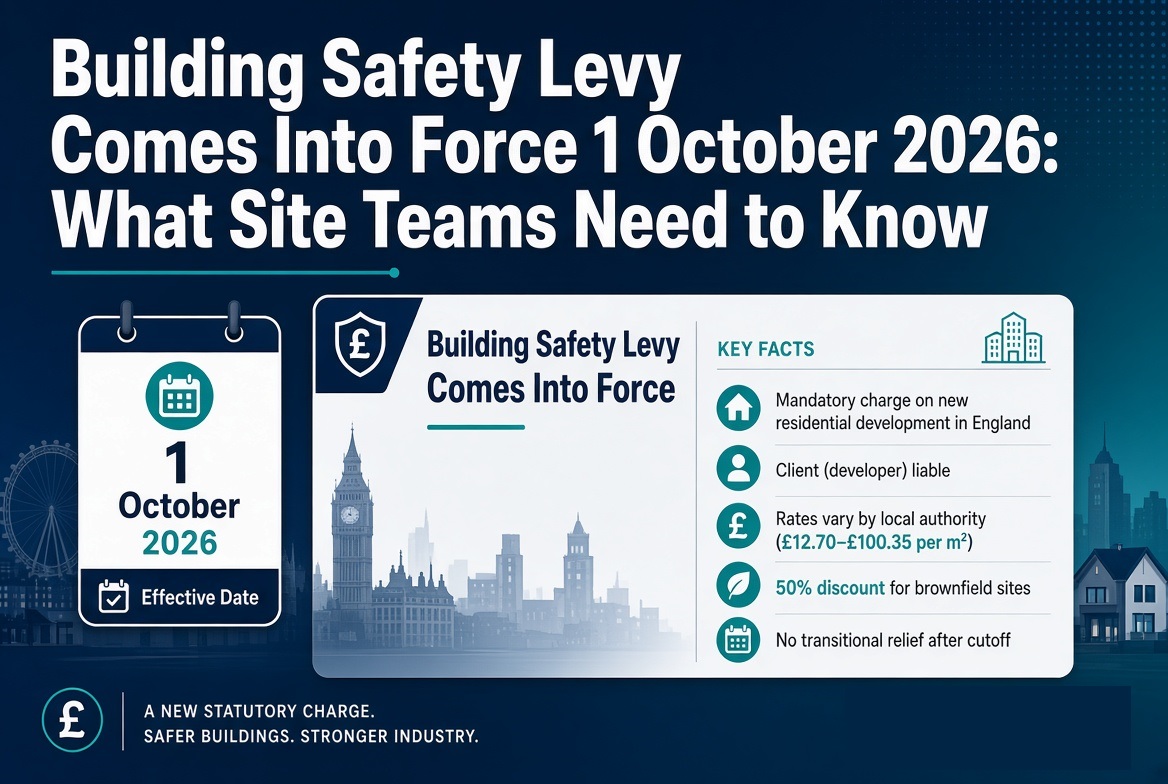
The Building Safety Levy is a new tax on most new residential development in England, introduced to raise money toward fixing historic building safety defects. It applies to new residential buildings, purpose-built student accommodation, extensions, and changes of use to residential accommodation, as well as mixed-use schemes that include residential space.
The Levy applies only to building control applications submitted on or after 1 October 2026, applications submitted before that date aren't liable, even if they're later amended or varied. There are no transitional provisions once the cutoff passes.
Who pays, and how much
The client, not the contractor, is liable to pay the Levy, and it's collected by local authorities rather than central government. Rates are set per square metre of chargeable floor space and vary significantly by local authority, weighted against average local house prices. At the extremes, developers in Kensington and Chelsea face the highest rate at £100.35 per square metre, while County Durham sits at the lowest, £12.70 per square metre.
There's a built-in incentive for brownfield development: sites classed as previously developed land qualify for a 50% discount on the standard rate. Certain categories are exempt entirely, including non-profit registered social housing providers.
Why this matters beyond the finance team
For site managers and compliance officers, the Levy itself isn't something you'll administer directly, but two things are worth flagging on live and upcoming projects:
- Timing now affects viability decisions. Projects with building control applications planned close to the October cutoff may see submission timing brought forward deliberately to avoid the charge, which can compress design and pre-construction programmes.
- It's part of a wider shift, not an isolated change. The Levy sits alongside continuing changes to construction product regulation and evolving Building Safety Act requirements, 2026 is shaping up as a year of tightening documentation and accountability expectations generally, not just on this one charge.
The bigger picture
The Levy is designed to raise a specific sum from residential developers over the next decade to fund remediation work, and it comes after developers had already committed billions toward self-remediation and related taxes ahead of it, so it's landing on an industry that's already absorbing significant compliance cost. Whether or not it directly touches your role, it's another sign of the same direction of travel across UK construction: documentation, timing, and accountability are all under closer scrutiny than they were even two years ago.
If your projects are approaching a building control submission near the 1 October 2026 cutoff, it's worth confirming with your client or developer where that application currently sits, the difference of a few weeks either side of the date has real cost implications.