
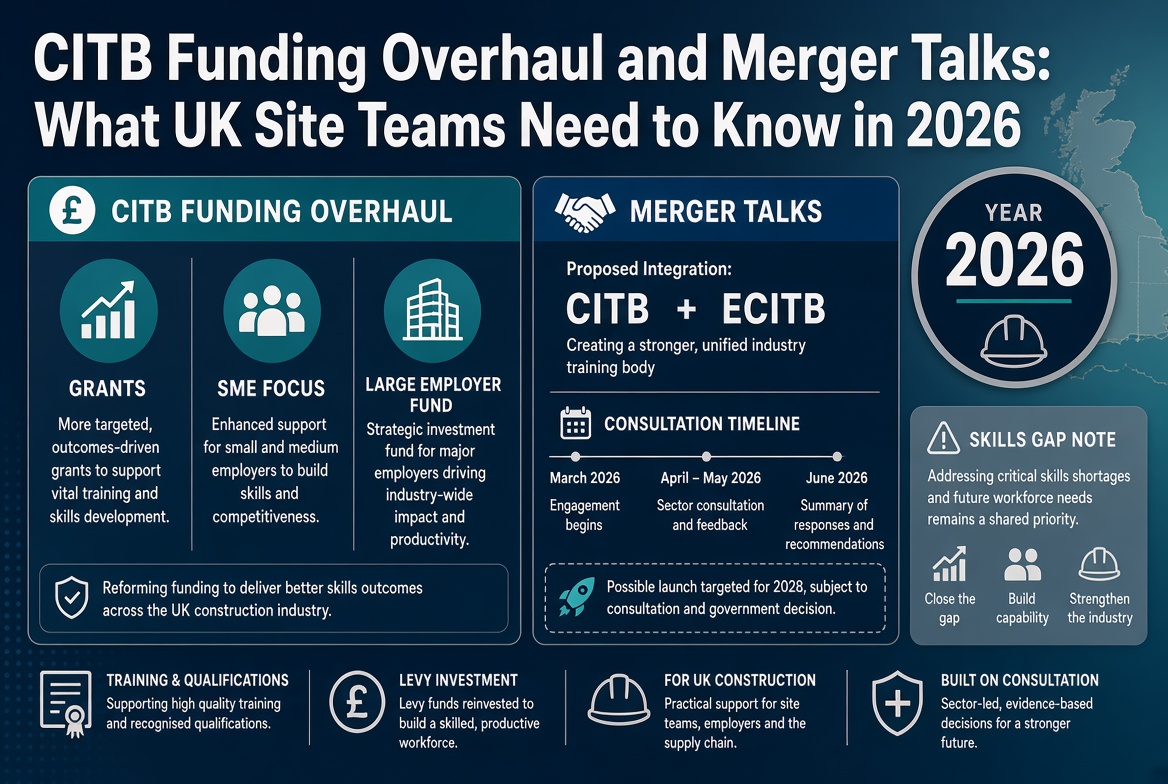
2026 has been a turning-point year for the Construction Industry Training Board (CITB), the body that collects the levy funding much of UK construction training. Between funding reform, a landmark skills report, and consultation on merging with its engineering counterpart, site managers and compliance teams have a lot to track. Here's a plain-English roundup.
Funding rules have changed
Rising demand forced CITB's hand this year. Employer uptake of its Employer Networks programme has grown 36% over four years, and by February the training board had already committed its entire Q1 budget for Employer Network courses, pausing new funding bookings until April.
In response, CITB restructured its support from April 2026:
- Employer Networks funding now focuses on micro, small and medium employers (1–249 staff).
- A new Large Employer Fund was introduced as a one-year interim measure for 2026–27 while CITB develops longer-term support for bigger firms.
- Grants for short courses were reduced, with achievement grants for non-apprentices standardised at £600, and funding for Level 7 qualifications and long-course attendance grants stopped.
Employers can still access Short Course Grants (including plant and scaffolding standards) and guidance through CITB's New Entrant Support Team (NEST).
Why it matters on site: budget changes affect how quickly training slots and grant funding can be secured. Site and compliance teams renewing certifications or booking statutory training should build in extra lead time and confirm current grant eligibility before assuming a course is funded.
Industry Picture 2026: a structural skills gap
CITB's Industry Picture 2026 report, published in February, delivered a blunt message: the construction skills gap is structural, not a temporary blip, and current productivity isn't enough to offset worker shortages. The report calls for coordinated action across four themes — making construction a more attractive career, connecting training to real job opportunities, improving flexibility to retain workers at every career stage, and better use of technology.
For compliance-focused site teams, the technology point is particularly relevant. As experienced supervisors and temporary works coordinators become harder to replace, tools that reduce admin burden and build competence checks into everyday workflows — rather than relying purely on headcount — become part of the industry's answer to the gap, not just a nice-to-have.
A single training board? Still undecided
The most consequential story is still unresolved. In March, the Department for Work and Pensions (DWP) opened a 12-week consultation on merging CITB with the Engineering Construction Industry Training Board (ECITB) into a single Industry Training Board, following a 2023 review by Mark Farmer that recommended a unified body. The consultation closed on 14 June 2026, and a government decision has not yet been published.
Industry response has been split. The Federation of Master Builders (FMB) formally opposed the merger, warning it could dilute the voice of small and micro building firms unless the new structure guarantees SME representation. The Chartered Institute of Building (CIOB) took a different angle, questioning whether restructuring solves the underlying skills shortage at all, and pushing for CITB to refocus on its core levy-collection role rather than its broader strategic activities.
Both CITB and ECITB leadership have stressed that existing levy arrangements — including the 2026–28 levy order — continue regardless of the consultation outcome, and that day-to-day training support will not be interrupted during any transition. If the merger proceeds, the new body is expected to launch in early 2028.
Why it matters on site: nothing changes operationally yet. Levy payments, funded training routes and existing CITB registrations remain valid. The main action for compliance leads is to watch for the government's response later in 2026, since it will shape which body administers funding from 2028 onward.
The takeaway for site managers and TWCs
None of these changes affect your legal duties under CDM 2015 or BS 5975 — but they do affect how training gets funded and delivered over the next two years. With CITB itself flagging a widening skills gap, the practical response at site level is the same regardless of how the merger lands: keep training records current, don't assume a course is funded until you check, and make sure competence tracking doesn't rely on any one person's memory. That's exactly the kind of record-keeping KaelSite's certificate and expiry tracking is built to support, so nothing slips through when training budgets and providers are in flux.
Sources: CITB (citb.co.uk); Department for Work and Pensions consultation announcement, March 2026; Industry Picture 2026, CITB; Construction News; Construction Enquirer; SIMIAN; Building; Construction Management (CIOB response); Federation of Master Builders.