
Case one: platform collapse, City of London
HSE guidance is clear that temporary structures must be designed, installed and maintained to withstand any foreseeable loads. That guidance became relevant in the worst way at a construction project at Paxton House in the City of London, where a drilling operative sustained fractures to his neck and back when a temporary platform loaded with concrete debris collapsed on top of him.
HSE's investigation found a series of failures relating to the planning, design and management of temporary works on site. It also found there had been no direct supervision of the drilling team in the days leading up to the incident, and confusion among operatives about where they should and shouldn't be working underneath one another.
At Westminster Magistrates' Court on 11 June 2026, Roots Contractors Limited pleaded guilty to breaching Regulation 16(2) of the Construction (Design and Management) Regulations 2015 and was fined, with costs awarded against the company.
Case two: wall collapse into an excavation, Poole
The second case is even starker, because there was no temporary works procedure at all. At a site in Poole, a newly built blockwork wall was backfilled before the mortar had properly set. The wall collapsed into the excavation it bordered, crushing a 69-year-old steel-fixer against the concrete floor and leaving him with life-changing injuries.
Matrod Frampton Limited pleaded guilty to breaching Regulations 13(1) and 19(1) of the Construction (Design and Management) Regulations 2015 at Bristol Magistrates' Court in December 2025, and was fined £100,000 plus costs and a victim surcharge. Speaking after the hearing, the HSE inspector on the case made the point plainly: getting the design and execution of temporary works right is a fundamental part of preventing this kind of incident.
The pattern, not the incident
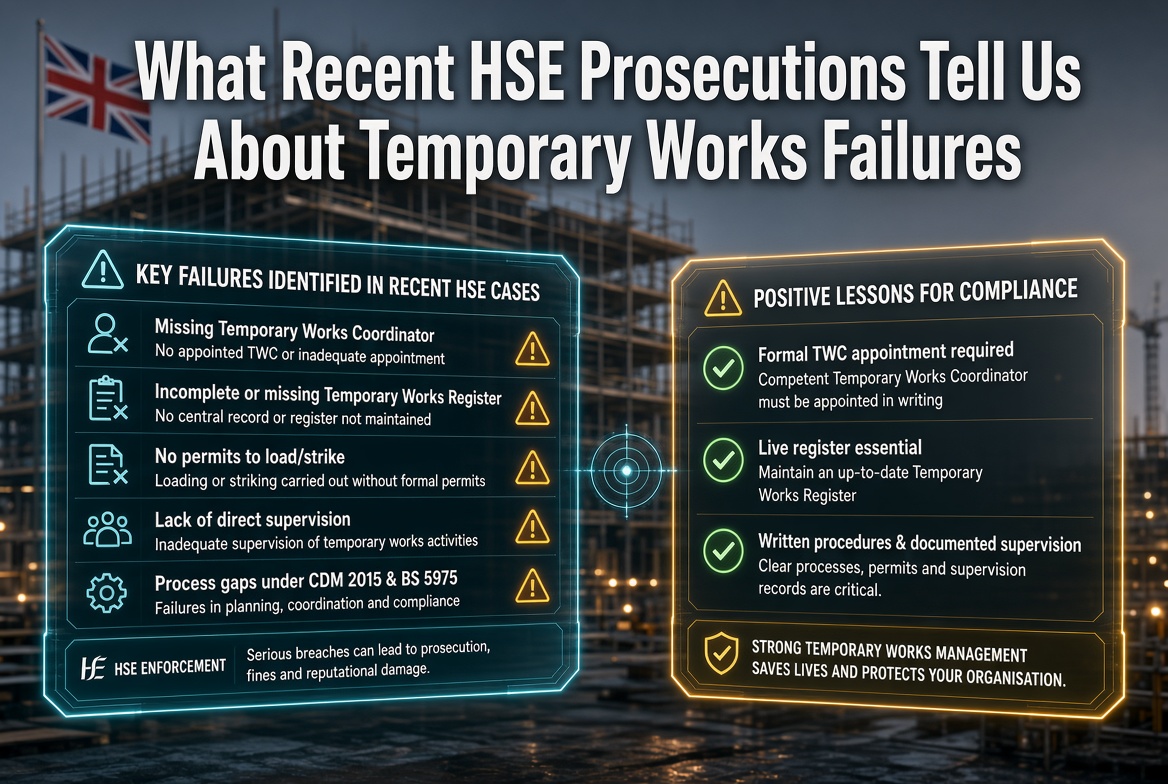
Individually, these read as one-off site failures. Together, they describe the same gap: HSE prosecution outcomes tend to involve familiar site failures rather than obscure technical risks , hazards that were already known but weren't controlled strongly enough at the point of work. Neither case needed better engineering. Both needed:
- A Temporary Works Coordinator formally appointed and actively managing the process
- A written temporary works procedure, not an informal arrangement
- A live register tracking what's designed, checked, permitted and in use
- Direct supervision of crews working near or on temporary structures
None of that is new guidance. It's the same TWC/TWS framework under BS 5975 that most sites already claim to follow , the difference is whether it's actually being run, or exists as a folder nobody opens.
What this means for site teams
The direction of travel from HSE enforcement isn't softening. Recent HSE enforcement activity signals continued focus on temporary works failures, particularly collapses and excavation interfaces, alongside principal contractor duty failures and weak management systems. For principal contractors and TWCs, that makes three things worth checking now rather than after an incident:
- Is your Temporary Works Register actually current , not just started, but updated as works progress, checked, and struck?
- Can you show a permit to load or strike was issued before the work proceeded, not written up afterwards?
- Is supervision documented, not just assumed? If HSE asks who was on site checking installation against the approved design that week, is there a record?
These are exactly the gaps that surface in enforcement action, not because the underlying engineering was wrong, but because nobody could show the process was followed.
If your temporary works records currently live in a folder, a WhatsApp thread, or someone's memory, that's the risk these two cases point to directly. KaelSite's Form Studio and Regular Inspections features let you keep a live Temporary Works Register, issue timestamped permits, and log supervision checks with photo evidence , offline if needed , so the record exists before HSE ever has to ask for it.
Sources: HSE Media Centre press releases, June 2026 and December 2025; The Workers Union.