Utilities Construction: Work Items, Site Inspections and Compliance
Utilities infrastructure provides essential services to homes, businesses, public buildings and industrial facilities. Construction projects involving utilities may include installing new service networks, extending existing infrastructure, diverting buried services or upgrading connections as part of a wider development.
These projects require careful coordination because utility work often takes place alongside roads, buildings, drainage systems and other live infrastructure. Incorrect installation, damage to existing services or incomplete records can create safety risks, costly rework and difficulties during future maintenance.
For UK construction teams, structured inspections and clear reporting help document the condition of work, identify defects and maintain a record of installation activities. KaelSite provides a dedicated Utilities project type to support digital inspection and reporting workflows. Explore the full construction project types guide.
Utilities construction: KaelSite catalogue overview
KaelSite’s Utilities project type includes:
-
28 work items
-
109 inspection links
These are KaelSite-specific catalogue figures. Inspection links represent associations between work items and inspections, not a count of unique inspection types or a universal checklist of mandatory utility checks.
The applicable inspections depend on the type of utility, the installation design, the network operator’s requirements, the construction method and the project specification.
1. What does utilities construction involve?
Utilities construction covers the installation, alteration, diversion and maintenance of infrastructure that supplies essential services or supports the operation of a building or development.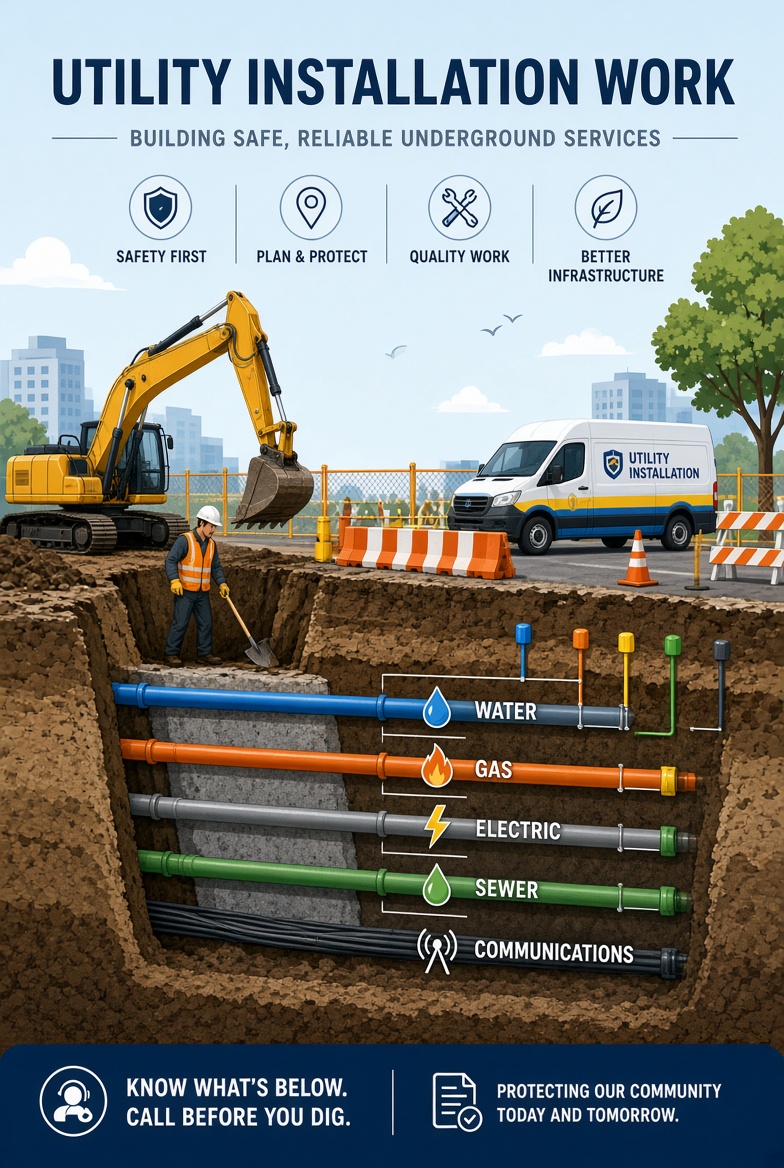
Depending on the project, this can involve:
-
Electricity distribution and electrical service infrastructure.
-
Gas supply networks and associated connections.
-
Water supply pipes and service connections.
-
Foul and surface water networks where included in the utility scope.
-
Telecommunications and data infrastructure.
-
Ducting, chambers and service corridors.
-
Utility diversions to accommodate new construction.
-
Connections between new installations and existing networks.
-
Testing, commissioning, reinstatement and handover.
These are illustrative examples of utilities work, rather than a claim that every activity is included in the KaelSite catalogue.
The scope can vary considerably. A new residential development may require several utility providers and different connection arrangements, while a commercial or infrastructure project may involve diversions, capacity upgrades or work within an existing network.
The project team should establish the relevant inspection and testing requirements before work starts, taking account of approved drawings, specifications, network-owner standards and applicable legal obligations.
2. Planning utility routes and coordinating existing services
One of the first challenges in utilities construction is establishing where existing services are located and how new installations will interact with them.
Underground networks can be congested, particularly in urban areas and established developments. Available records may be incomplete, and services may not follow the positions shown on older drawings.
Before excavation or installation, the team should establish a suitable approach to identifying and managing existing services.
Depending on the site, this may involve:
-
Reviewing available utility records and site drawings.
-
Identifying the proposed route of the new service.
-
Using appropriate detection methods to investigate buried services.
-
Marking identified services and relevant exclusion areas.
-
Confirming excavation methods and access arrangements.
-
Coordinating work with utility owners and other contractors.
-
Recording unexpected services or discrepancies.
-
Resolving design or routing conflicts before installation proceeds.
Utility information should be treated according to its reliability. Drawings and detection results support planning, but they do not guarantee the exact location of every buried service.
Where the actual site conditions differ from the available records, the discrepancy should be documented and referred to the appropriate person for assessment.
The Health and Safety Executive provides guidance on avoiding danger from underground services.
3. Excavation, trenches and service corridors
Utility installation frequently involves trenches, pits, chambers or other excavations. These activities can expose workers to risks from ground collapse, moving plant, buried services, water ingress and restricted access.
The construction method should account for ground conditions, excavation depth, nearby structures and the presence of existing infrastructure.
Relevant inspection considerations may include:
-
Excavation alignment, dimensions and required depth.
-
Ground conditions and signs of instability.
-
Suitable excavation support or other protective measures.
-
Safe access and egress.
-
Water ingress and drainage arrangements.
-
Protection of exposed existing services.
-
Plant movements and segregation of work areas.
-
Bedding and formation preparation before installation.
The appropriate controls and inspection frequency should be established by competent personnel in accordance with the site conditions and construction method.
If an excavation becomes unstable or conditions change, the team should reassess the work rather than relying on an earlier inspection.
Digital records can help capture observations, photographs and corrective actions, providing a traceable record of issues identified during excavation.
4. Ducting, pipes and cable installation
After routes and excavations have been prepared, utility infrastructure can be installed in accordance with the approved design and the relevant network requirements.
Different systems have different installation methods and acceptance criteria. Water pipes, gas pipelines, electrical ducts and telecommunications infrastructure should not be treated as interchangeable simply because they occupy similar construction corridors.
Depending on the installation, inspection activities may consider:
-
Correct materials and components.
-
Route, alignment and installation depth.
-
Bedding, supports and protection.
-
Separation from other services where required.
-
Joints, couplings and connections.
-
Bends, draw ropes and access arrangements for ducts.
-
Protection at crossings and interfaces.
-
Identification, labelling and warning provisions.
-
Compliance with the relevant drawings and specification.
The required separation distances, cover depths and installation details should be taken from the applicable design and network-owner requirements rather than assumed from a generic checklist.
Where an installation will be concealed by backfilling, encasement or subsequent construction, required inspections should take place before the relevant work is covered.
Photographs and location records can provide useful supporting evidence. They should complement, not replace, specified inspections and technical acceptance.
5. Electrical utilities and power infrastructure
Electrical utility work may involve service ducts, cable routes, distribution infrastructure, earthing arrangements and connections to existing systems. The precise scope depends on whether the project concerns a distribution network, a building supply or another electrical installation.
Electrical work requires appropriate competence, planning and control of electrical hazards. Work on or near existing electrical infrastructure must follow the relevant safety arrangements and authorisation procedures.
Depending on the project, inspection and reporting may cover:
-
Cable routes, ducts and protective arrangements.
-
Installation details against approved drawings.
-
Cable identification and labelling.
-
Earthing and bonding where required by the design.
-
Protection of installed cables during subsequent work.
-
Required electrical tests and test documentation.
-
Defects or damage identified during installation.
-
Completion records and relevant approvals.
The required tests depend on the installation and applicable standards. A visual construction inspection does not establish that an electrical installation is safe or correctly commissioned.
Where work interfaces with a live network, the project team should coordinate with the relevant network operator and authorised personnel. Required isolation, access and commissioning procedures must be followed.
6. Water, gas and other service networks
Water and gas installations have different technical and safety requirements. Each network must be installed and tested in accordance with its approved design and applicable standards.
For water infrastructure, relevant activities may include pipe installation, jointing, connections, pressure testing, flushing or other specified procedures. The requirements depend on the system, its intended use and the relevant water company or asset owner.
Gas infrastructure requires particular attention to approved materials, jointing methods, testing, network-owner procedures and the risks associated with gas release. Work must be undertaken by appropriately competent and authorised people.
Telecommunications and data networks may involve ducts, chambers, cable installation, jointing, identification and testing against the relevant specification.
Across these different systems, project records may need to capture:
-
The utility type and installation location.
-
Materials and components used.
-
Relevant inspection findings.
-
Required test results and associated references.
-
Defects, corrective actions and retesting.
-
Network-owner inspections or approvals.
-
As-built information and handover records.
The specific evidence required should be agreed for each system. A single generic inspection checklist is not sufficient to establish compliance across all utility types.
7. Connections, diversions and interfaces with existing networks
New utility infrastructure often needs to connect to existing assets. These interfaces can introduce additional technical and coordination challenges, particularly where the existing network remains operational.
Diversions may also be required when new buildings, roads, foundations or drainage systems conflict with existing service routes.
Before the work proceeds, the project team should establish the approved connection or diversion method and identify the parties responsible for authorisation, execution and acceptance.
Inspection and reporting considerations may include:
-
Confirming the correct connection location.
-
Verifying the installation against approved drawings.
-
Recording the condition of existing assets where relevant.
-
Coordinating access, shutdowns and service interruptions.
-
Checking completed joints and interfaces.
-
Recording specified testing and commissioning results.
-
Documenting changes from the original design.
-
Updating as-built records to reflect the completed installation.
Where an unexpected service or connection conflict is discovered, the team should record the issue and refer it to the appropriate designer, utility owner or authorised representative.
Unapproved changes can affect safety, network performance and future maintenance. Any departure from the intended installation should follow the project’s technical review and change-control process.
8. Backfilling, reinstatement and protection of completed work
Once an installation has been inspected and the required checks have been completed, the work may proceed to backfilling and reinstatement.
This stage is important because defects in buried installations can become expensive and disruptive to investigate after the excavation has been closed.
Depending on the project specification, relevant checks may include:
-
Confirmation that required pre-backfill inspections are complete.
-
Suitable backfill materials.
-
Placement and compaction in specified layers.
-
Protection of pipes, ducts and cables.
-
Installation of required warning or identification provisions.
-
Reinstatement of roads, footways, verges or other surfaces.
-
Compliance with the requirements of the relevant asset owner.
-
Recording the final route and installation details.
The specified backfill and reinstatement methods will depend on the utility, surrounding ground, surface type and applicable standards.
If a required inspection, test or approval remains outstanding, the team should resolve it before concealing the work where the project requirements demand this.
Clear records at this stage help demonstrate what was installed and how the completed area was reinstated.
9. Testing, commissioning and handover
Utility installations may require testing and commissioning before they can be accepted, connected to a live network or put into service.
The applicable procedures vary by system. They may include pressure or leakage testing, electrical testing, continuity checks, flushing, functional testing or other specified verification activities.
Testing should be undertaken by appropriately competent people using the methods and acceptance criteria established for the installation.
A useful handover record may include:
-
The scope and location of the completed installation.
-
Relevant inspection records.
-
Required test results and supporting documents.
-
Details of defects and their resolution.
-
Required commissioning records.
-
Approved changes and variations.
-
As-built drawings and asset information.
-
Relevant network-owner approvals or acceptance records.
A test should not be marked as satisfactory solely because the activity has taken place. The result must be reviewed against the applicable acceptance criteria, and failures or outstanding issues must be addressed.
Clear handover information can help the asset owner operate, maintain and repair the network throughout its service life.
10. Managing safety and compliance on utility projects
Utility work can involve several overlapping risks and legal requirements. The relevant controls depend on the activities, the network involved, the site and the parties undertaking the work.
Construction (Design and Management) Regulations 2015
CDM 2015 establishes duties for relevant construction project participants, including clients, designers and contractors. These duties cover the management of health, safety and welfare during construction.
For utility projects, risk management may need to consider excavation, underground services, lifting operations, plant movement, temporary works and interfaces with existing infrastructure.
See the HSE’s CDM 2015 guidance.
Electricity and underground services
Existing electrical cables and other buried services can present serious hazards during excavation. Suitable planning, service identification, detection and safe digging procedures are essential.
The HSE’s underground services guidance provides further information.
Network-owner and technical requirements
Utility owners and operators may impose specific requirements for design, materials, installation, testing, connection, inspection and acceptance.
Project teams should establish the applicable requirements before work begins and maintain the records needed to demonstrate that the specified activities have been completed.
Environmental and reinstatement obligations
Depending on the project, utility construction may also be subject to environmental controls, highway requirements, permits, consents or reinstatement conditions.
These requirements should be confirmed for the particular location and work scope rather than inferred from a generic inspection checklist.
Important: Digital inspection and reporting workflows help organise evidence, but they do not replace competent technical assessments, required tests, safe systems of work or formal approvals.
11. How KaelSite supports utilities construction workflows
Utility projects often involve several work packages, specialist contractors and stages of inspection before an installation can be concealed, connected or handed over.
KaelSite’s Utilities project type provides a structured catalogue of work items and associated inspection links that teams can use to organise digital site inspections and reporting.
Depending on the project and configured workflow, teams can use KaelSite to help:
-
Organise inspections around relevant work items.
-
Record site observations and installation defects.
-
Capture photographs and supporting information.
-
Maintain clearer inspection and reporting records.
-
Track findings through the relevant workflow.
-
Support consistent documentation across different site activities.
KaelSite is designed as a mobile-first compliance app for UK construction teams, with offline-first functionality to support work on sites where connectivity is limited.
Core inspection and reporting workflows are available on mobile and web. Advanced features, including full Report Editing and AI Report Drafting, are available on the web.
The app supports the organisation of project information. Technical acceptance, specialist testing, network-owner approvals and statutory responsibilities remain with the relevant competent or authorised people.
12. Improving traceability from installation to handover
A completed utility installation needs a clear record of what was installed, where it was installed, which inspections and tests were completed and how outstanding defects were resolved.
This is particularly important for buried infrastructure, where access for future investigation may require excavation or disruption to operational areas.
A structured digital workflow can help connect work items to inspection findings, photographs, corrective actions and handover documentation. It can also help teams identify missing information before work is concealed or a project reaches completion.
The most effective process is one aligned with the approved design, technical specification, inspection and test plan and requirements of the relevant network owner.
Explore the KaelSite construction project types catalogue to see how work items and inspection links are organised across different types of UK construction projects.
Frequently asked questions
What does utilities construction include?
Utilities construction can include electricity, gas, water, telecommunications, service ducting, utility connections, diversions and related infrastructure. The exact scope depends on the project and the networks involved.
What inspections are needed for utility installation?
The required inspections depend on the utility type, design and technical specification. They may cover routes, installation depth, materials, joints, protection, testing, backfilling and reinstatement. The project’s approved inspection and test plan should define the applicable requirements.
Why are pre-backfill inspections important?
Once pipes, ducts and cables are buried, it can be difficult to inspect their installation without reopening the ground. Where required by the project, inspections and tests should be completed and recorded before the work is concealed.
What records should be included in a utility handover?
Depending on the installation, records may include inspection findings, test results, commissioning documents, as-built information, defect close-out evidence and required network-owner approvals.
Can utilities inspections be managed digitally?
Digital workflows can help teams organise inspections, record defects, attach photographs and maintain reporting records. They support project documentation but do not replace specialist testing, technical approval or the relevant safety procedures.
How does KaelSite support utilities projects?
KaelSite provides a Utilities project type with 28 work items and 109 inspection links in its catalogue. It supports digital inspection and reporting workflows for UK construction teams, including offline-first use where connectivity is limited.
Organise utilities inspections with KaelSite
Utilities construction requires careful coordination, appropriate installation checks and reliable records of testing, defects and completed work. KaelSite helps construction teams organise digital inspections and reporting workflows across utility and other project types.
Explore the KaelSite construction project types catalogue to learn more about the available work item and inspection structure.

Comments (0)
Add a Comment
No comments yet. Be the first to comment!